
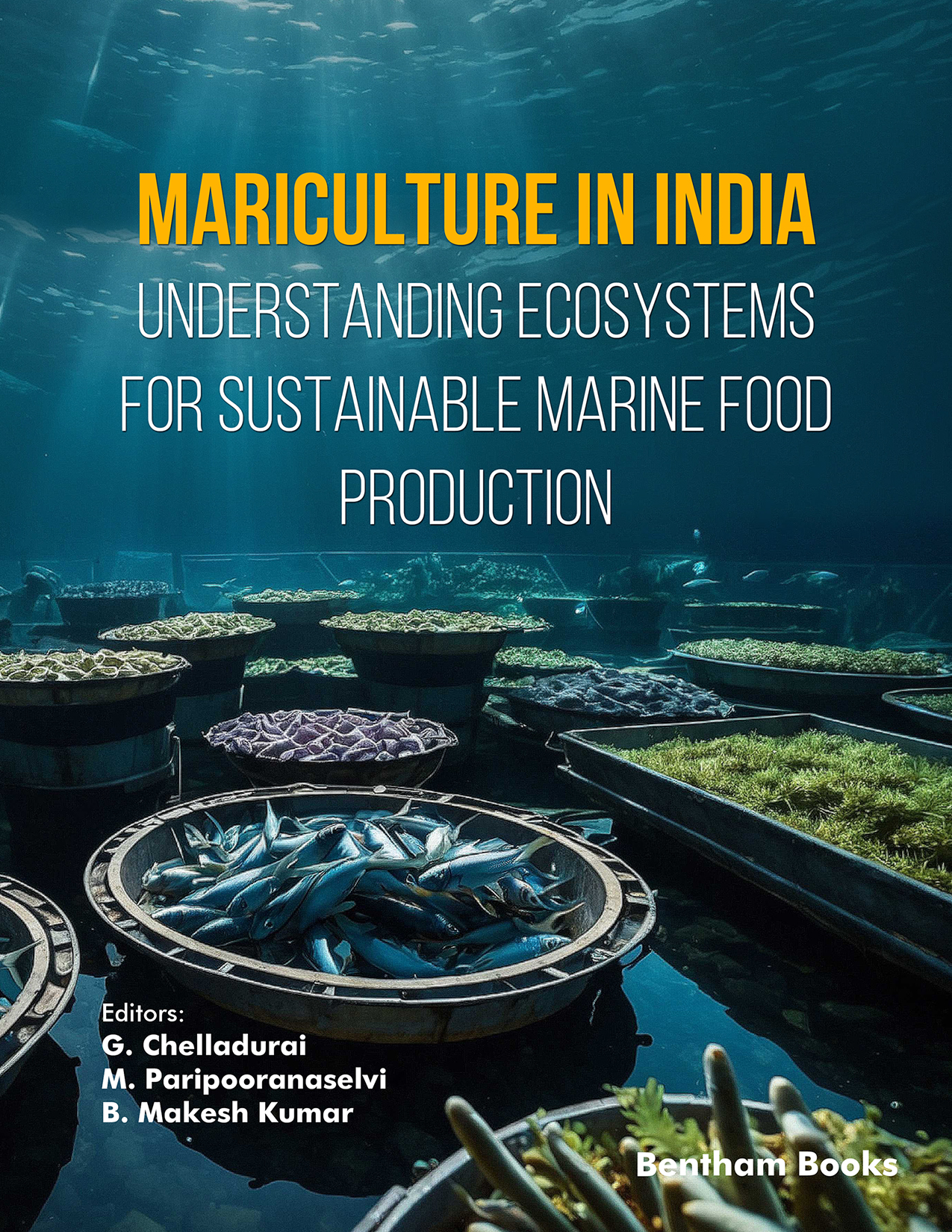
Editors: G. Chelladurai, B. Makesh Kumar, M. Paripooranaselvi

Mariculture in India: Understanding Ecosystems for Sustainable Marine Food Production

eBook: US $49 Special Offer (PDF + Printed Copy): US $108
Printed Copy: US $83
Library License: US $196
ISBN: 979-8-89881-658-2 (Print)
ISBN: 979-8-89881-657-5 (Online)
Year of Publication: 2026
DOI: 10.2174/97988988165751260101

Introduction

Mariculture in India: Understanding Ecosystems for Sustainable Marine Production explores the growing importance of sustainable marine aquaculture in supporting global food security, livelihoods, and coastal economies. The book highlights modern mariculture practices, technological advancements, environmental challenges, and management strategies for sustainable aquatic production systems.

The book begins with global mariculture production trends, fisheries development, and India's contribution to the sector. It discusses major farming systems, including shrimp, seaweed, lobster, crab, oyster, and ornamental fish culture, along with cage farming and integrated multi-trophic aquaculture (IMTA). Dedicated chapters examine mariculture pollution, biodiversity impacts, disease management, aquafeed development, and the role of biotechnology in improving productivity and sustainability. The book also addresses environmental monitoring, biosecurity, precision fish farming, sustainable feed management, and regulatory frameworks for responsible mariculture practices.


Key Features

  • - Comprehensive overview of global and sustainable mariculture practices.
  • - Covers IMTA, cage culture, aquafeed, and biotechnology applications.
  • - Provides insights into disease management, pollution control, and biodiversity conservation.
  • - Discussions on sustainable policies, precision fish farming, and environmental monitoring.
  • - Real-world strategies for improving productivity and coastal resource management.

Target Readership :

Researchers, academics, postgraduate students, and professionals in fisheries science, aquaculture and marine biology.

Foreword

The book “Mariculture in India: Understanding Ecosystems for Sustainable Marine Food Production” emphasizes the vital role of mariculture in global economic and community development. From the coast to the deep ocean floor, marine ecosystems represent the largest habitat system on Earth. This book provides a national forum for key information, ideas, and discussion on all aspects of mariculture.

Through a rapid, thorough, and open-access publishing approach, it presents advanced research that helps readers understand marine life, interactions among organisms, ecosystem functioning, and human interactions with the oceans. The book focuses on experimental work at all levels of biological organization, including ecological modeling and ecosystem studies, both in the laboratory and in the field.

The author has organized the book into diverse chapters, including Introduction of Global Mariculture Production and Development, Present Status, and Prospects of Mariculture, providing readers with insights into the current status, challenges, and future potential of the sector. Further chapters, such as Water Resources for Sustainable Mariculture and Mariculture Pollution and Biodiversity, expand knowledge for researchers and offer guidance for addressing ecological challenges. Chapters on Management of Sustainable Mariculture and Development of Aqua Feed for Mariculture Species present key issues in aquaculture development and offer frameworks for improving sustainability from both socioeconomic and ecological perspectives.

The final chapters, Role of Biotechnology in Sustainable Mariculture and Planning and Regulation of Sustainable Mariculture, explore how biotechnology, through nutrition, feeding stimuli, chemical signals, and the reduction of in-pond chemical oxygen demand, can support sustainable practices. All articles, including original research and reviews, have undergone peer review by subject-matter experts and esteemed editors, ensuring the highest quality for the scientific community.

It is a privilege to write the foreword for this book, which thoroughly examines the structure and development of mariculture in India. The book’s wide range of topics, authored by experts in their respective fields, provides a comprehensive overview of ecosystem-based, environmentally friendly mariculture practices. I firmly believe the knowledge presented here will be highly beneficial, thought-provoking, and inspirational for the entire scientific community.

S.B. Sharma
Vice-Chancellor
Millennium University
Blantyre
Republic of Malawi