
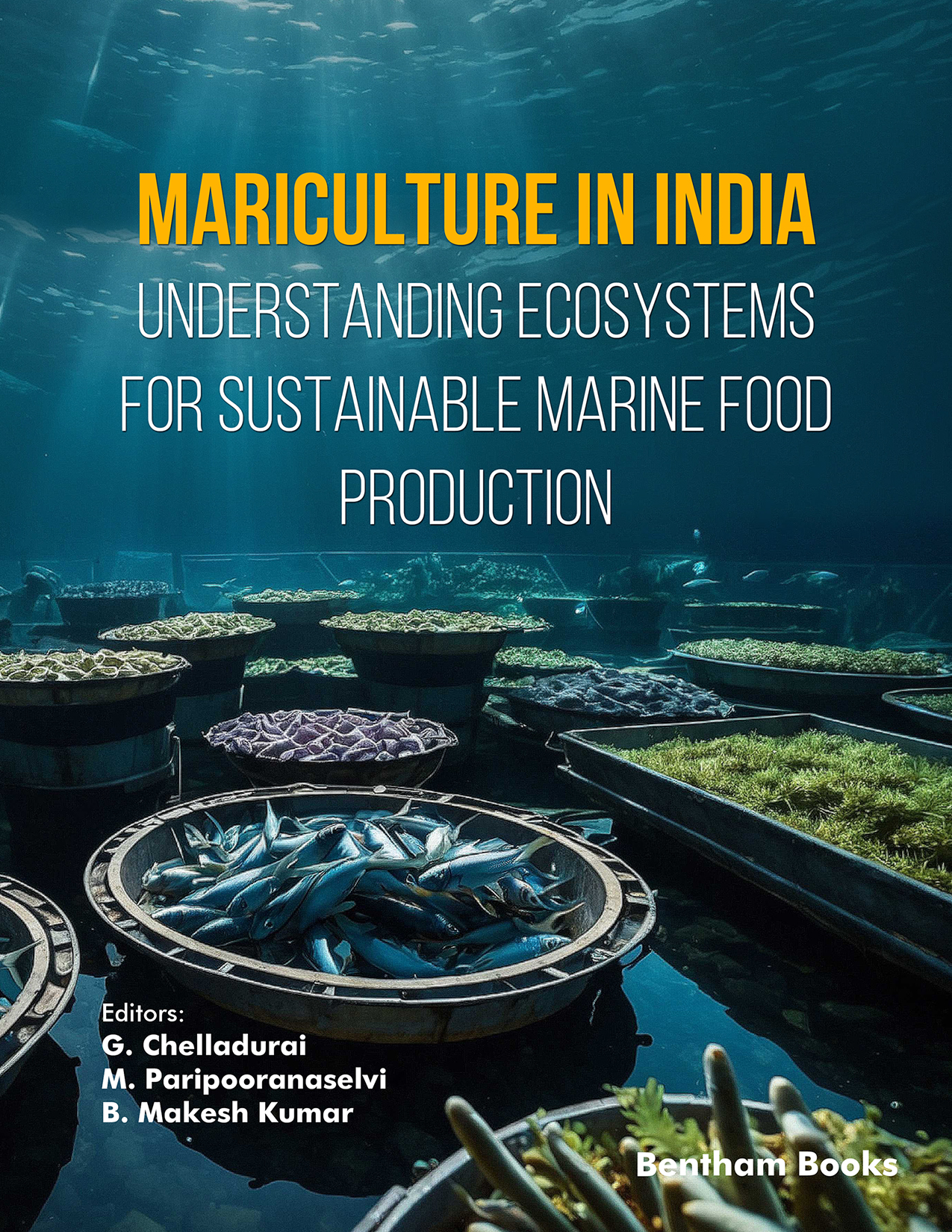
Editors: G. Chelladurai, B. Makesh Kumar, M. Paripooranaselvi

Mariculture in India: Understanding Ecosystems for Sustainable Marine Food Production

eBook: US $49 Special Offer (PDF + Printed Copy): US $108
Printed Copy: US $83
Library License: US $196
ISBN: 979-8-89881-658-2 (Print)
ISBN: 979-8-89881-657-5 (Online)
Year of Publication: 2026
DOI: 10.2174/97988988165751260101

Introduction

Mariculture in India: Understanding Ecosystems for Sustainable Marine Production explores the growing importance of sustainable marine aquaculture in supporting global food security, livelihoods, and coastal economies. The book highlights modern mariculture practices, technological advancements, environmental challenges, and management strategies for sustainable aquatic production systems.

The book begins with global mariculture production trends, fisheries development, and India's contribution to the sector. It discusses major farming systems, including shrimp, seaweed, lobster, crab, oyster, and ornamental fish culture, along with cage farming and integrated multi-trophic aquaculture (IMTA). Dedicated chapters examine mariculture pollution, biodiversity impacts, disease management, aquafeed development, and the role of biotechnology in improving productivity and sustainability. The book also addresses environmental monitoring, biosecurity, precision fish farming, sustainable feed management, and regulatory frameworks for responsible mariculture practices.


Key Features

  • - Comprehensive overview of global and sustainable mariculture practices.
  • - Covers IMTA, cage culture, aquafeed, and biotechnology applications.
  • - Provides insights into disease management, pollution control, and biodiversity conservation.
  • - Discussions on sustainable policies, precision fish farming, and environmental monitoring.
  • - Real-world strategies for improving productivity and coastal resource management.

Target Readership :

Researchers, academics, postgraduate students, and professionals in fisheries science, aquaculture and marine biology.

Preface

The oceans have long been the cradle of life, sustaining civilizations through their vast biodiversity and invaluable resources. In an era marked by rapid population growth and increasing pressure on natural resources, the need for sustainable and responsible food production from marine ecosystems has become more critical than ever. Mariculture, as an emerging scientific discipline and expanding industry, offers a promising pathway to address food security challenges while preserving the delicate balance of marine environments.

This book, Mariculture in India: Understanding Ecosystems for Sustainable Marine Food Production, has been conceived to provide a comprehensive insight into the ecological, biological, and technological foundations of mariculture in the Indian context. It presents an integrated perspective on the rich marine biodiversity of India, advances in culture technologies, ecosystem-based management approaches, and the socio-economic dimensions of sustainable marine food production. The central emphasis of this work is to bridge scientific knowledge with sustainable practices, ensuring that mariculture contributes not only to nutrition and livelihoods but also to the conservation and responsible stewardship of marine ecosystems. The chapters in this book are contributed by experts who bring together their research findings and practical experiences. Collectively, they offer a valuable resource for students, researchers, academicians, policymakers, and practitioners seeking a deeper understanding of mariculture and its pivotal role in building a sustainable future.

We hope that this volume will inspire continued research, innovation, and responsible practices in marine food production systems, while reinforcing our shared responsibility to protect and sustain the ecosystems that support life. It is our firm belief that promoting sustainable mariculture in India will play a significant role in strengthening national food security, supporting economic development, and conserving marine biodiversity.

We express our sincere gratitude to all contributors, reviewers, and supporting institutions whose cooperation made this work possible. We also thank our readers for their interest and engagement with this important field of study.

G. Chelladurai
G.V.N. College (Autonomous), Kovilpatti
Thoothukudi district
Tamil Nadu, India

M. Paripooranaselvi
Department of Zoology
St. Mary’s College (Autonomous), Thoothukudi
Tamil Nadu, India

&

B. Makesh Kumar
G.V.N. College (Autonomous), Kovilpatti
Thoothukudi district
Tamil Nadu, India