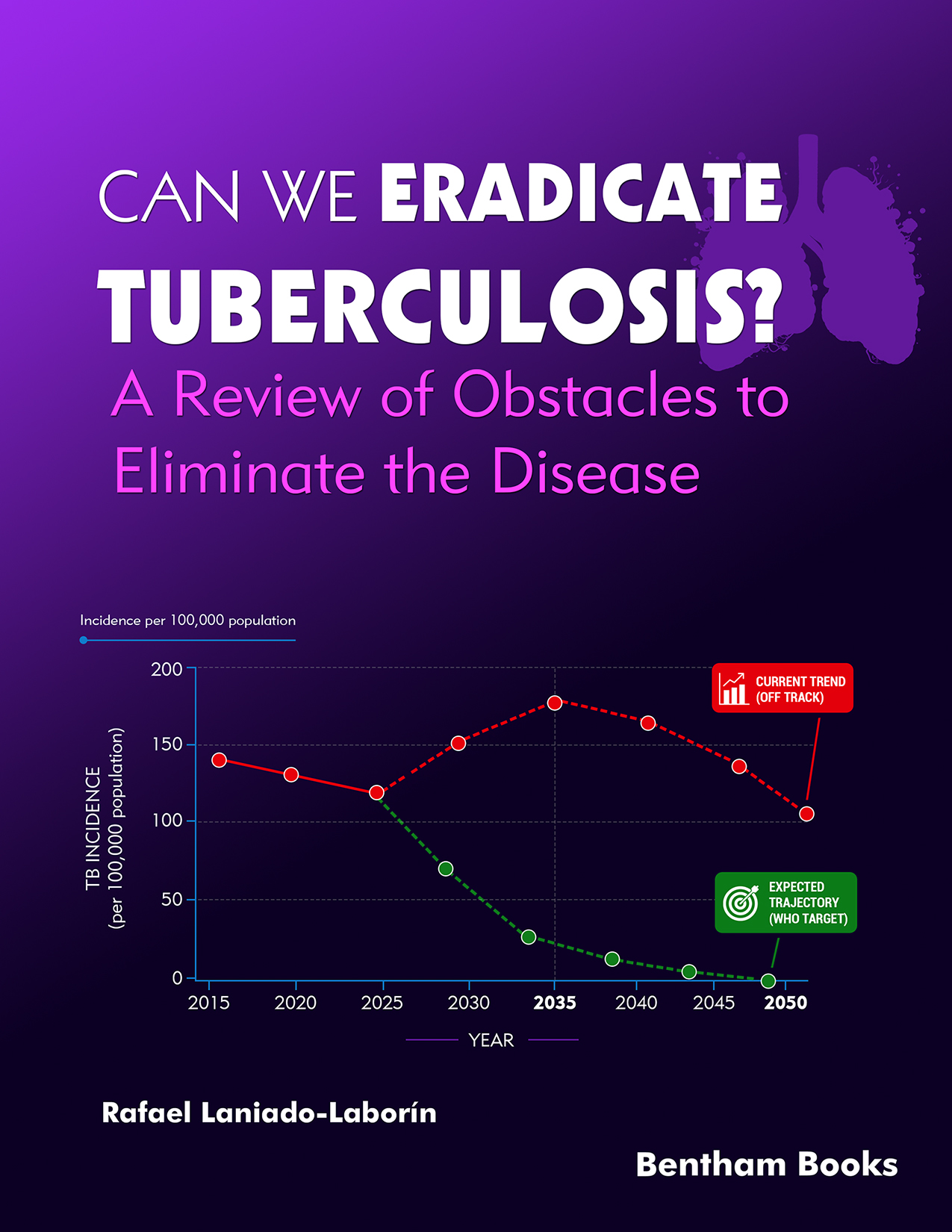
Integrity. It is a word that is used for specific purposes in medical and public health research. The term defines a set of guiding values, including rigor, transparency, open communication, respect, and accountability [1]. At its core is the practice of honesty in how we think about health conditions. Integrity forms the foundation of the work undertaken by Dr. Rafael Laniado-Laborin in this book, Can We Eradicate Tuberculosis? A Review of Obstacles to Eliminate the Disease.
Dr. Laniado-Laborin explores an invisible killer that has devastated humanity for thousands of years. Mycobacterium tuberculosis—the bacterium that causes the disease known as “TB”—has been found in prehistoric mummies [2], leaving an ancient archeological record of suffering. And while the world we live in has radically changed in those same centuries, TB continues to persist as one of the deadliest and most challenging diseases known to humankind.
The latest data from the World Health Organization, published in 2024, quantifies some of the global misery caused by TB [3]. It estimates that more than 10 million people became sick with TB in 2023, a number that has failed to decline despite numerous promises to end the disease within the next decade. While emphasizing these commitments to eradicating TB, the WHO document reports that we still have a long way to go. TB has once again become the leading infectious killer of adults worldwide. Yet, on page 6, the report optimistically notes that: “there are several positive trends following strong post-COVID recovery efforts that continued in 2023. These include: the global rise in the number of people falling ill with TB each year has slowed and started to stabilize; the global number of people dying from TB each year continues to fall; the WHO African and European regions have made good progress towards the 2025 milestones for reductions in the TB incidence rate and the number of deaths caused by TB; the globally reported number of people newly diagnosed with TB reached a new high in 2023; the treatment success rate for people with drug-susceptible TB has been sustained at a high level and continues to improve for people with drug-resistant TB; the coverage of TB preventive treatment has been sustained for people living with HIV and continues to improve for household contacts of people diagnosed with TB.”
There has indeed been some remarkable progress in the fight against this deadly disease. But we have come up far short when it comes to stopping this formidable foe. The focus on these achievements glosses over the immeasurable human suffering that continues to be caused by TB each year. Dissecting these statistics reveals that of the 10 million people who became sick with TB in 2023, almost 2.7 million were not diagnosed or started on treatment. More than a million people died in one year from a condition that has been treatable and preventable for decades. There seems to be little to celebrate in these grim numbers. Yet victory narratives continue to guide much of the discourse on global approaches to TB. Continuing to focus on how far we have come often distracts us from what else we need to do. It is a disconnect that has been paid for with people’s lives.
Integrity. When used colloquially, the term refers to having strong moral principles. Such ethical principles are at the heart of Dr. Laniado-Laborin’s new book. They guide him to be brave enough to ask a critical question: why has TB continued to plague people around the world? His powerful truth-telling springs from years of dedicated service to people living with the disease. He is an international expert with deep roots in the Tijuana community. His years working as a physician alongside and listening to people impacted by TB bring to this book a rich and exceptional perspective, allowing him to sensitively explore the corners of humanity where TB has a stranglehold.
With a keen eye for connection, he links the dots between the current TB pandemic and other human misfortunes, revealing that the causes of TB’s persistence are as much social as they are biological [4]. Mycobacterium tuberculosis is spread through the air and can theoretically make any person who breathes sick, a common trait for all humanity. Yet the burden of suffering caused by TB is not commonly shared. More so than many other diseases, TB exposes the fault lines in how humans relate to one another. Dr. Laniado-Laborin thoughtfully exposes how TB capitalizes on these created inequalities, turning them to its advantage.
Can We Eradicate Tuberculosis? analyzes how TB impacts the most vulnerable in society. It shines a light on TB in vulnerable populations, bringing to the forefront people who have substance use disorder, people who are incarcerated, and people on the move. These are populations that most societies would rather forget about. Dr. Laniado-Laborin has made them the central players in both his service work and in his book. His scholarly endeavor, however, goes beyond merely exposing these social woes. The book also brings a lens of compassionate determination to address the myriad problems facing these populations. The essence of Can We Eradicate Tuberculosis? is a deep compassion grounded in the foundations of human rights. It exemplifies another meaning of integrity—the state of being whole—in situating TB within the larger context in which the disease continues to occur.
This book is timely, badly needed in an era when the very foundations of medical care and public health are under attack by powerful nations. The United States government has significantly reduced investment in TB services [5]—in an approach to global health that appears to lack integrity. The possibility that millions more lives will be unnecessarily lost or compromised by this age-old disease—and human indifference to it—has never been so great. However, these current threats to TB also offer an opportunity to reset how we, as a community of concern, approach the disease. Dr. Laniado-Laborin’s insightful solutions, eloquently shared in this book, offer an ideal place to recenter and reinvigorate the global fight against TB.
The noted author John Green—whose recent book “Everything is Tuberculosis” also aims to change the paradigm by which we address humanity’s most notable infectious killer—emphasizes that the integrity contained in a humanistic response to TB can spark “virtuous cycles.” In a chapter of this same name, he states, “Vicious cycles are common. Injustice and unfairness permeate every aspect of human life. But virtuous cycles are also possible” [6]. This book by Dr. Laniado-Laborin is poised to set in motion a more ethical, moral, and sustainable approach to TB. The noted physician, anthropologist, and TB advocate, Dr. Paul Farmer, would often refer to the lasting positive effects that can result from these virtuous cycles as “collateral benefits” [7]. That is, by choosing to tackle a disease like TB with integrity and in a dignified way that prioritizes the humanity of each person, society gains in unanticipated positive ways. In our divided world, such virtuous acts are badly needed. Can We Eradicate Tuberculosis? offers a roadmap not just for halting the onslaught of TB but also for restoring the integrity required to collectively heal the injustices that seem to define our current world.
Jennifer Furin, MD, PhD
Department of Global Health and Social Medicine
Harvard Medical School
Boston, Massachusetts, USA