
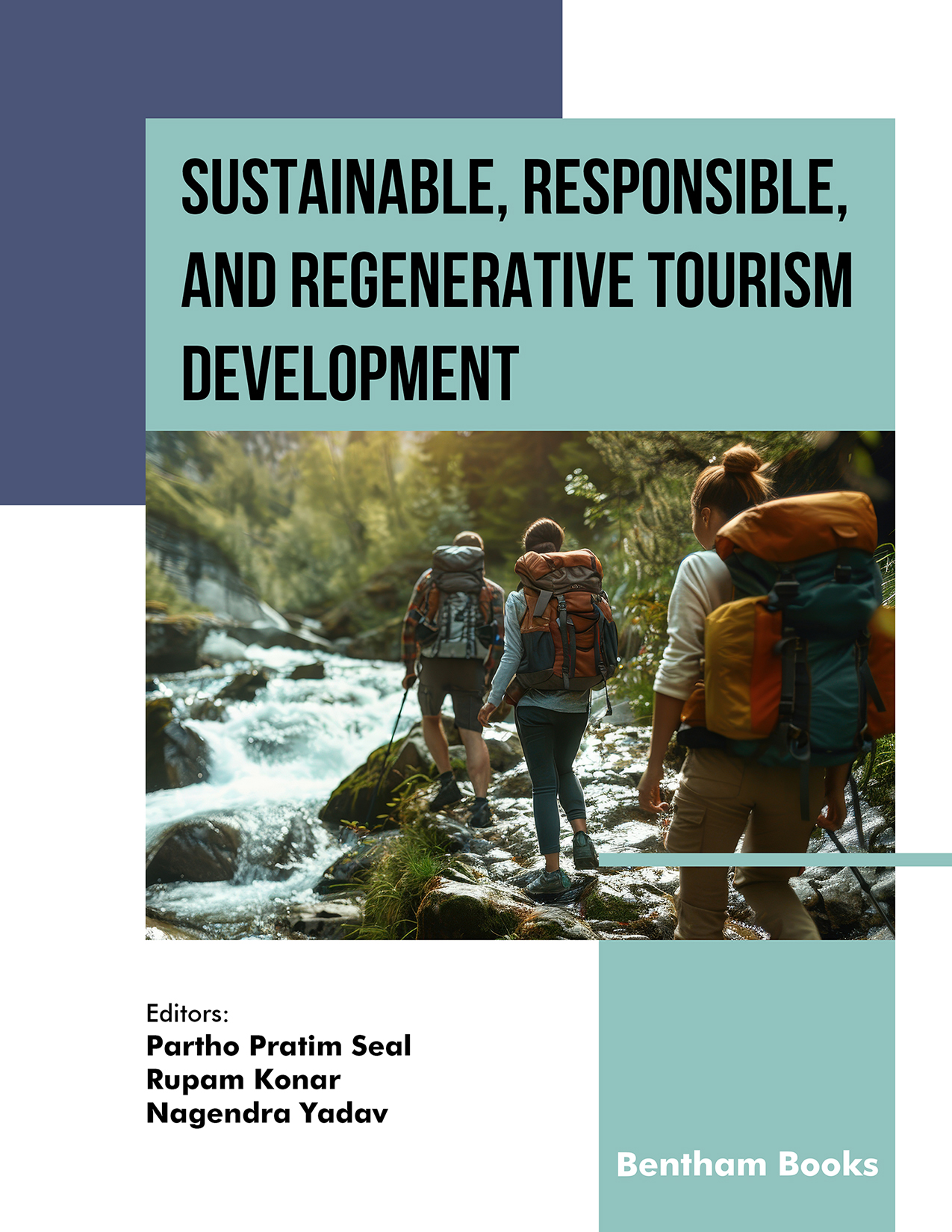
Editors: Partho Pratim Seal, Rupam Konar, Nagendra Yadav

Sustainable, Responsible, and Regenerative Tourism Development

eBook: US $39 Special Offer (PDF + Printed Copy): US $99
Printed Copy: US $79
Library License: US $156
ISBN: 979-8-89881-739-8 (Print)
ISBN: 979-8-89881-738-1 (Online)
Year of Publication: 2026
DOI: 10.2174/97988988173811260101

Introduction

Sustainable, Responsible, and Regenerative Tourism Development explores the evolving landscape of global tourism at a time of significant disruption driven by climate change, technological advancement, shifting consumer behaviour, and widening socio-economic inequalities.

Structured across nine thoughtfully designed chapters, the book reframes tourism not merely as an economic activity, but as a powerful instrument for social equity, environmental stewardship, and long-term regenerative development. It begins with an analysis of heritage site generation in Malaysia, highlighting how domestic tourists’ values and attitudes influence preservation outcomes. It then expands into collaborative destination management, emphasising the role of public, private, and community partnerships in sustainable governance. Community-based tourism is explored through rural Asian and African contexts, demonstrating how local empowerment, capacity building, and participatory planning can drive inclusive growth.

Further chapters provide comparative policy insights into environmental conservation frameworks and evaluate the need for reform in tourism education and professional training to support sector-wide transformation. The book also investigates the role of digital technologies such as virtual reality, augmented reality, and blockchain in enhancing visitor experiences and operational transparency. Emerging trends such as staycations are analysed in relation to AI, robotics, and localised travel models that can mitigate overtourism while strengthening community-level economies.


Key Features

  • - Comprehensive coverage of sustainable, responsible, and regenerative tourism frameworks.
  • - Integration of heritage conservation, policy analysis, and community-based tourism models.
  • - Examination of digital technologies, including VR, AR, blockchain, AI, and robotics, in tourism.
  • - Comparative insights from Asia, Africa, and global destination management practices.
  • - Focus on green innovation and financial resilience in tourism-dependent economies.
  • - Policy-oriented discussion on education, governance, and regulatory reforms.
  • - AI-driven decision-support systems for sustainable tourism planning and risk management.

Target Readership :

Researchers, academics, and postgraduate students in tourism management, sustainability studies, environmental policy, and hospitality management.

Foreword

It is my privilege to present “Sustainable, Responsible, and Generative Tourism Development,” a volume that directly addresses the urgent need for innovation and change in the tourism industry. As issues like climate change, overtourism, digital upheavals, and evolving stakeholder expectations have reached critical levels, the tourism sector must go beyond basic sustainability rhetoric to adopt models that actively regenerate and improve destinations, communities, and ecosystems. This book responds to that challenge by outlining a forward-looking approach from sustainable to regenerative tourism development. The chapters, written by a diverse group of scholars from the Global South, adopt a multidisciplinary perspective, integrating behavioral studies, entrepreneurial policy, technology, and community involvement. Collectively, they showcase that tourism can and should serve as a proactive force in restoring environments, bolstering social systems, and ensuring resilience for the future.

The book's chapters, including examples from Malaysian World Heritage Site regeneration, Japan's green innovation impacts, Vietnam's eco-adventure projects, and Europe's AI-driven decision support, offer recommendations for positive change. Emphasizing regenerative tourism, several chapters explore how policies, technology, and collaborative governance not only reduce negative effects but also create real benefits for communities. The work highlights the real-world challenges the sector faces, including gaps between policy and practice, hurdles to digital adoption, and the importance of community trust. Discussions on leadership, stakeholder collaboration, and digital tools like AI and early warning systems show that innovation must be inclusive and context-sensitive. This book provides new insights and practical guidance for scholars, policymakers, and practitioners dedicated to evolving tourism beyond the basic and common concept of sustainability. It encourages a shift toward a place-based and regenerative mindset that actively restores and co-creates value for destinations and their communities.

I commend the editors and contributors for their vision, scholarly rigor, and dedication. I believe this volume will be a beneficial resource for anyone aiming to steer tourism toward a more fair, just, and generative future.

S. Mostafa Rasoolimanesh
Department of Sustainable Tourism,
School of Business and Law,
Edith Cowan University,
Joondalup, Australia