
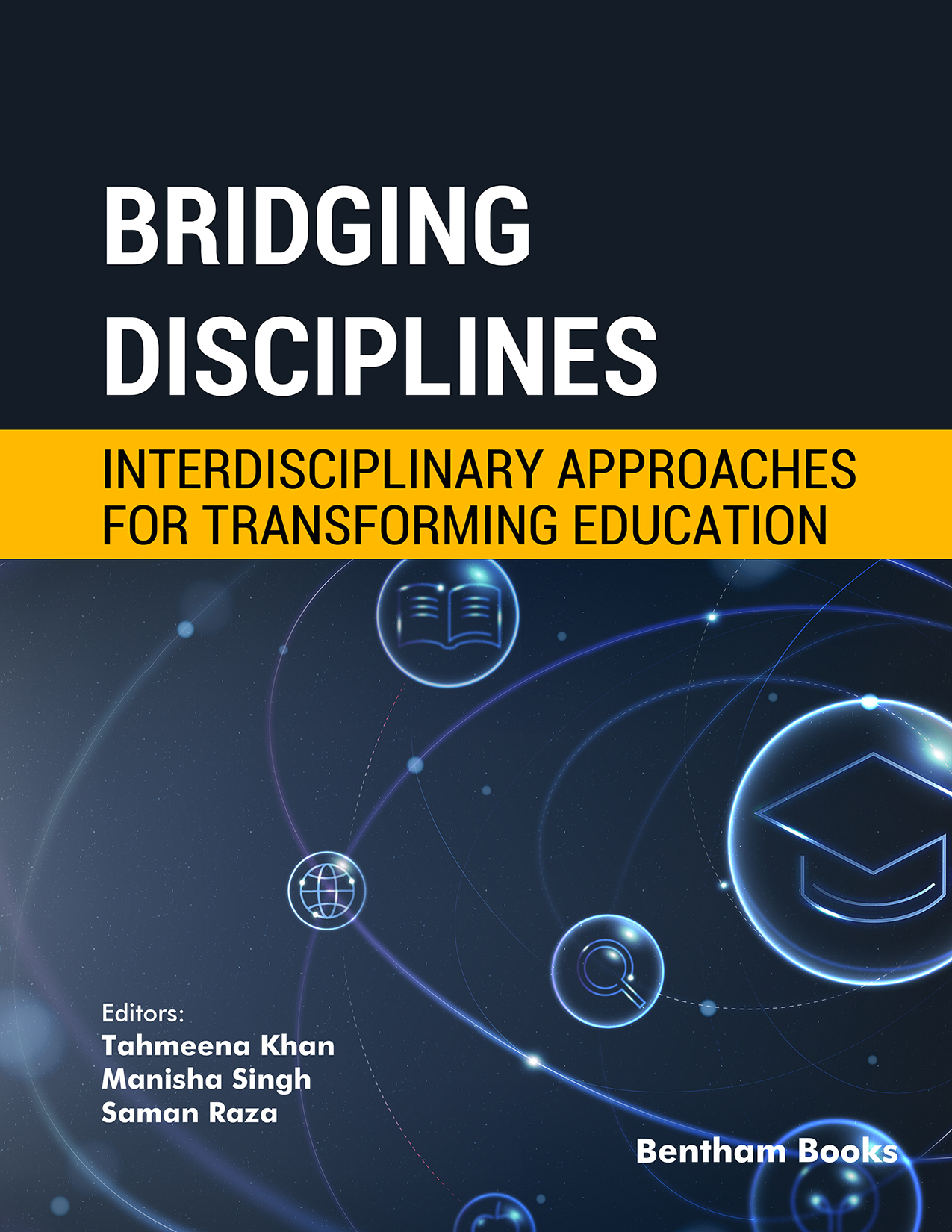
Bridging Disciplines: Interdisciplinary Approaches for Transforming Education

Editors: Tahmeena Khan, Manisha Singh, Saman Raza

Bridging Disciplines: Interdisciplinary Approaches for Transforming Education

ISBN: 979-8-89881-649-0
eISBN: 979-8-89881-648-3 (Online)

Introduction

Bridging Disciplines: Interdisciplinary Approaches for Transforming Education challenges traditional subject boundaries and highlights integrative teaching approaches that promote interdisciplinary learning as a way to prepare students for a complex, fast-changing world.

The book presents 14 self-contained chapters covering key themes such as STEAM education, curriculum redesign, pedagogical innovation, and cross-disciplinary integration in fields including commerce, ICT, sociology, environmental studies, architecture, and languages. It also explores AI-assisted teaching, blended learning, and creative instructional tools to enhance engagement and problem-solving.


Key Features

  • - Focus on interdisciplinary and STEAM-based education models.
  • - Practical strategies for curriculum design and teaching innovation.
  • - Integration of science, arts, social sciences, and technology.
  • - Inclusion of AI-assisted and blended learning approaches.
  • - Real-world examples of cross-disciplinary educational practices.

Target Readership :

Educators, researchers, and academics in education.

Foreword

I take this opportunity to write a foreword to the book titled “Bridging Disciplines: Interdisciplinary Approaches for Transforming Education”, edited by Dr. Tahmeena Khan, Dr. Manisha Singh, and Dr. Saman Raza, with whom I have been academically associated for the last 15 years. The book is a wonderful amalgamation of research and academics in the field of Science, Technology, Engineering, and Mathematics. This work is a masterpiece in emphasising the relevance of STEM in tackling global challenges across various areas of development and in sustaining human civilisation. It addresses the challenges of various life arenas, including science, Commerce, Technology, and achieving Developmental goals, as well as managing eco-balance and work-life balance, thereby covering the intersection of science and technology with sociology, economics, culture, and politics of a particular nation. The values imparted by research across different aspects of STEM shall provide a holistic learning approach for future generations. This has the potential to bridge the gap between education, rationalism, social norms, economics and foreign relations.

The study of STEM has imbued the application of Artificial Intelligence and its role in teaching and learning. The book contains contributions on diverse topics ranging from interdisciplinary aspects, integration of diverse fields, analytical creativity, environmental, cultural, social, and economic impacts, and an education system imparting knowledge in STEM. This book highlights an interdisciplinary approach to the field of education and emphasises the existence of a multi-faceted education and social system of our nation.

I appreciate the efforts of all the contributing authors, especially young minds who have conceptualised and written the chapters, throwing light on newer aspects of STEM. The growing need for interdisciplinary research has created a requirement for such an education system. The editors should be applauded for bringing out a collection that breaks all the traditional boundaries and sets up a new and deeper meaning towards understanding life. I wish this brainchild of the editors would ignite more minds towards the role of STEM in overall societal development.

Dr. Nidhi Mishra
Department of Applied Sciences
Indian Institute of Information Technology, Allahabad
Uttar Pradesh, India