
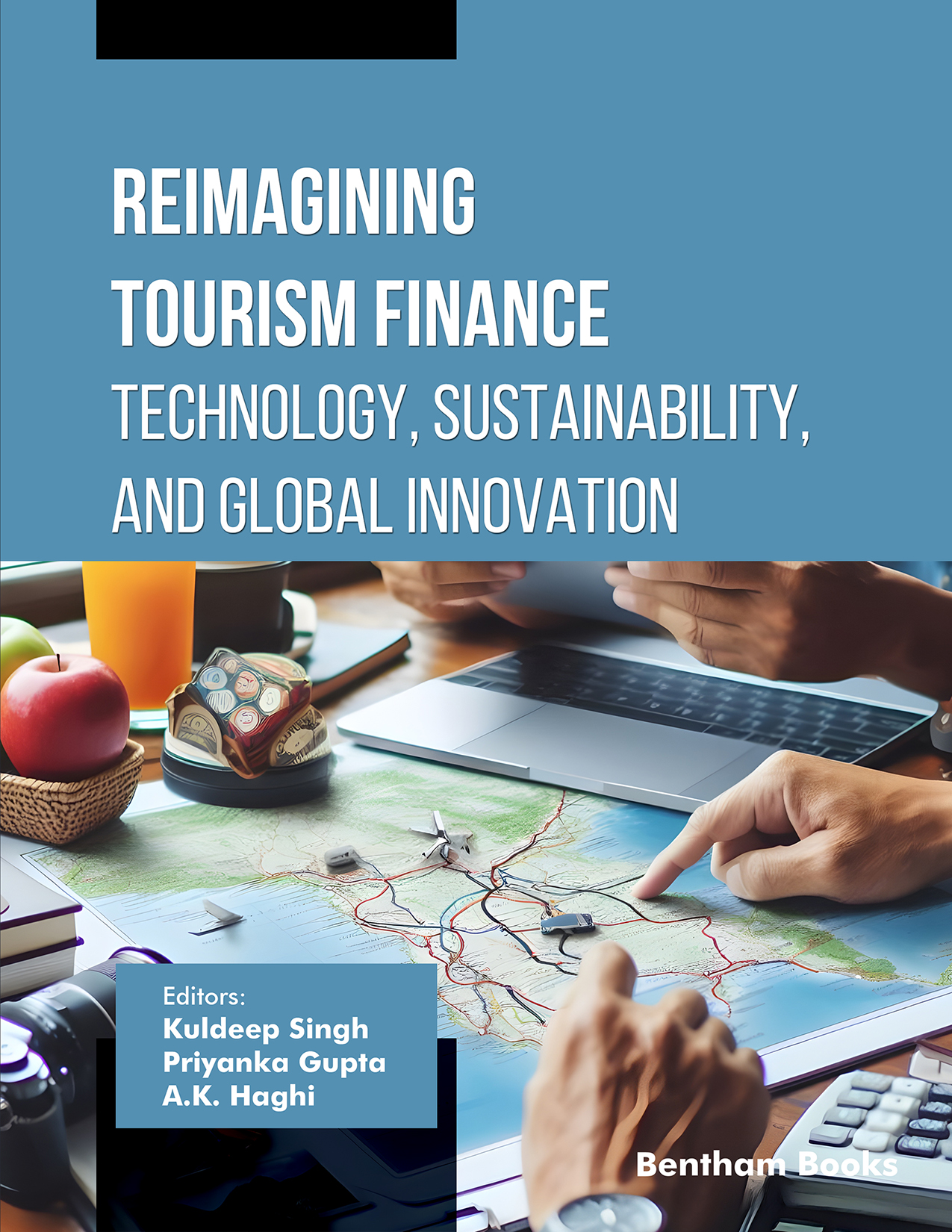
Editors: Kuldeep Singh, Priyanka Gupta, A.K. Haghi

Reimagining Tourism Finance: Technology, Sustainability, and Global Innovation

eBook: US $69 Special Offer (PDF + Printed Copy): US $134
Printed Copy: US $99
Library License: US $276
ISBN: 979-8-89881-544-8 (Print)
ISBN: 979-8-89881-543-1 (Online)
Year of Publication: 2026
DOI: 10.2174/97988988154311260101

Introduction

Reimagining Tourism Finance: Technology, Sustainability, and Global Innovation offers a forward-looking exploration of how financial innovation and advanced technologies are reshaping the tourism industry. The book focuses on balancing profitability with environmental sustainability and social equity, addressing key challenges in modern tourism.

It examines the role of emerging technologies such as blockchain and digital twins in transforming financial planning, risk management, transparency, and decision-making. Supported by global and regional case studies, the book provides practical insights and real-world relevance across diverse economic and geographic contexts.

Combining theory with practice, the book presents evidence-based analysis, conceptual models, and policy recommendations, helping bridge the gap between sustainable tourism development and financial innovation.


Key Features

  • - Focus on sustainable finance and innovation in tourism.
  • - Integrated perspectives on technologies like blockchain and digital twins.
  • - Global and regional case studies for practical insights.
  • - Multidisciplinary approach with policy and strategic frameworks.
  • - Combines theoretical concepts with real-world applications.

Target Readership :

Academics, students, researchers and professionals interested in tourism finance.

Preface

In the era of renewable energy, wind power stands as a key player in the global push for sustainable energy solutions. "Artificial Intelligence in Wind Energy: Transforming Green Energy Generation" explores how Artificial Intelligence (AI) is revolutionizing wind energy systems, improving efficiency, and driving the transition to cleaner energy sources. This book delves into the powerful synergy between AI and wind energy, offering practical insights and real-world examples of AI’s impact on the wind energy sector. From resource assessment to performance optimization and grid integration, this book covers how AI-driven decision-making tools and machine learning models for resource optimization enhance every aspect of wind energy generation. Readers will discover how predictive analytics in operations management enables real-time monitoring, efficiency improvements, and cost reduction. The book also discusses ethical considerations in algorithmic management, ensuring that AI is implemented responsibly in renewable energy applications. Practical examples, case studies, and applications in real-world scenarios illustrate AI's transformative potential in areas such as wind prediction, site selection, turbine maintenance, and hybrid energy systems. Additionally, the chapters explore the economic and environmental benefits of AI, alongside emerging trends and challenges in the field.

Sugandha Singh
School of Engineering and Technology
Noida International University
Greater Noida, Uttar Pradesh
India

Inam Ul Haq
School of Engineering and Technology (SET)
CGC University, Mohali, Punjab
India

Sachin Ahuja
Department of Engineering
Chandigarh University, Mohali, Punjab
India

Akib Mohi Ud Din Khanday
Department of Information Technology
Cluster University of Srinagar
Jammu and Kashmir
India

&

Neha Sharma
Department of Computer Science and Engineering
School of Engineering and Technology
Shree Guru Gobind Singh Tricentenary University
Gurugram, India