
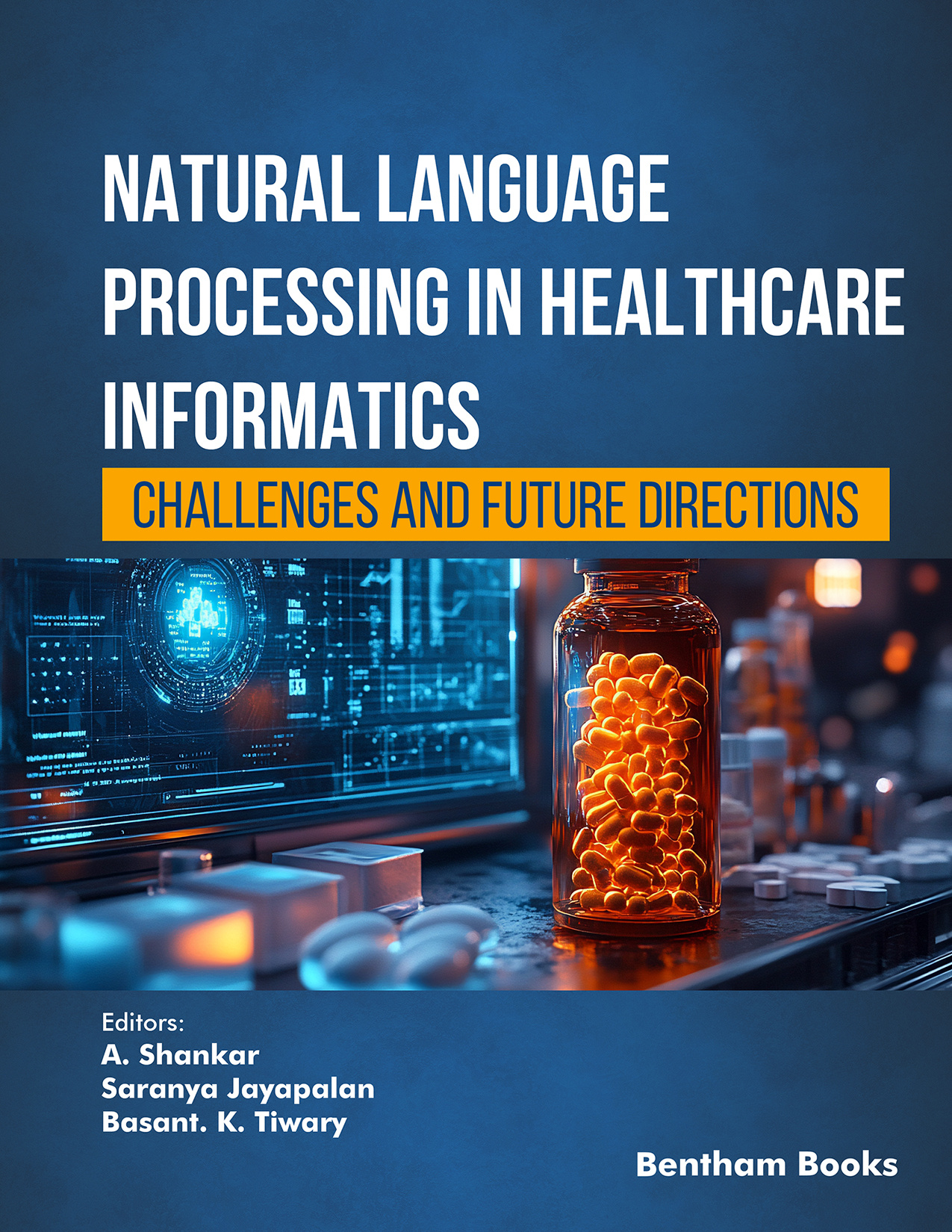
Natural Language Processing in Healthcare Informatics: Challenges and Future Directions

Editors: A. Shankar, Saranya Jayapalan, Basant. K. Tiwary

Natural Language Processing in Healthcare Informatics: Challenges and Future Directions

ISBN: 979-8-89881-493-9
eISBN: 979-8-89881-492-2 (Online)

Introduction

Natural Language Processing in Healthcare Informatics: Challenges and Future Directions is an exploration into the transformative role of NLP and AI technologies in modern healthcare systems. The book delves into foundational concepts, advanced deep learning techniques, and cutting-edge applications of NLP in clinical decision support, electronic health record analysis, medical literature mining, patient-provider communication, and personalised medicine.

Structured across ten detailed chapters, the volume covers both theoretical foundations and practical implementations. Early chapters introduce AI and NLP in healthcare, highlighting applications in telehealth, wearable technologies, robotic surgery, and FDA-approved AI devices. Subsequent chapters examine challenges unique to healthcare NLP, including data quality and standardisation, linguistic variability, computational limitations, and ethical considerations such as bias, transparency, and patient privacy.

The book also provides in-depth insights into deep learning approaches for medical text analysis, preprocessing and annotation strategies, the evaluation of large language models for RNA interactions, and the application of Bi-LSTM architectures for advanced healthcare NLP tasks. Innovative chapters explore the role of knowledge graphs in rare disease prediction, AI and ML for focused ultrasound treatments, mathematical modelling using fuzzy numbers for healthcare NLP trends, and AI/ML integration in drug discovery and personalised medicine.


Key Features

  • - Detailed discussions and case studies on the applications of AI and NLP in healthcare, including telehealth, EHR analysis, and medical imaging.
  • - In-depth coverage of challenges in healthcare NLP encompassing data quality, linguistic variability, computational requirements, and ethical considerations.
  • - Explores deep learning techniques: RNNs, CNNs, Transformers, Bi-LSTM, and their application to medical text.
  • - Gives practical guidance on data preprocessing, annotation, and evaluation for healthcare NLP tasks.
  • - Provides insight into emerging trends by integrating theoretical concepts with real-world implementations, coding examples, and model workflows in Python and MATLAB.

Target Readership:

Researchers, students and specialised professionals in healthcare bioinformatics, computer science and biomedical engineering.

Preface

Integrating healthcare and Artificial Intelligence (AI), particularly Natural Language Processing (NLP), holds great potential to significantly transform clinical practice, data-driven research, disease diagnosis, and drug discovery workflows. Healthcare is inherently information-rich, yet much of this information resides in unstructured formats: clinical notes, Electronic Health Records (EHRs), research publications, and patient feedback. Bridging the gap between this unstructured data and actionable knowledge is achieved through NLP. By enabling computers to understand, interpret, and generate human language, NLP empowers us to unlock patterns, trends, and crucial information that would otherwise remain hidden. In this book, we explore the fascinating realm of AI and NLP within the healthcare context. Our aim is to provide readers with a broad understanding of the principles, methodologies, and applications of AI-enhanced NLP in healthcare. From core concepts to advanced techniques and real-world case studies, this book is designed to equip healthcare professionals and researchers with the knowledge and insights needed to leverage NLP technologies for improving patient outcomes, clinical decision-making, and biomedical research.

As we begin our exploration of AI and NLP in healthcare, it is imperative to acknowledge the promise these technologies hold in revolutionizing the delivery of patient care and advancing medical research. Through synthesizing theoretical knowledge and practical visions, this book is intended for a diverse audience, including researchers, clinicians, data scientists, healthcare professionals, and students. Each chapter, spanning from initial conceptualization to practical implementation, provides readers with a deep dive into NLP's methodologies, challenges, data handling, its role in disease prediction, chatbots, and future trends within NLP-associated healthcare informatics. This book, "Natural Language Processing in Healthcare Informatics: Challenges and Future Directions," investigates this interdisciplinary discipline, exploring the intricate ways NLP is applied to extract meaningful insights from the vast sea of healthcare data.

We hope it is a valuable resource for understanding the NLP’s ability to reshape and inspire further innovation in this critical field. The editors thank all contributing authors and supporting institutions that enabled the completion of this volume. We gratefully acknowledge the support provided by the Indian Council of Medical Research (ICMR), Government of India, in facilitating this work.

A. Shankar Department of ECE
Manakula Vinayagar Institute of Technology
Puducherry, India
Current Affiliation
Department of ECE
Hindusthan College of Engineering & Technology
Coimbatore

Saranya Jayapalan Department of Bioinformatics
Pondicherry University
Puducherry, India

&

Basant K. Tiwary
Department of Bioinformatics
Pondicherry University
Puducherry, India