
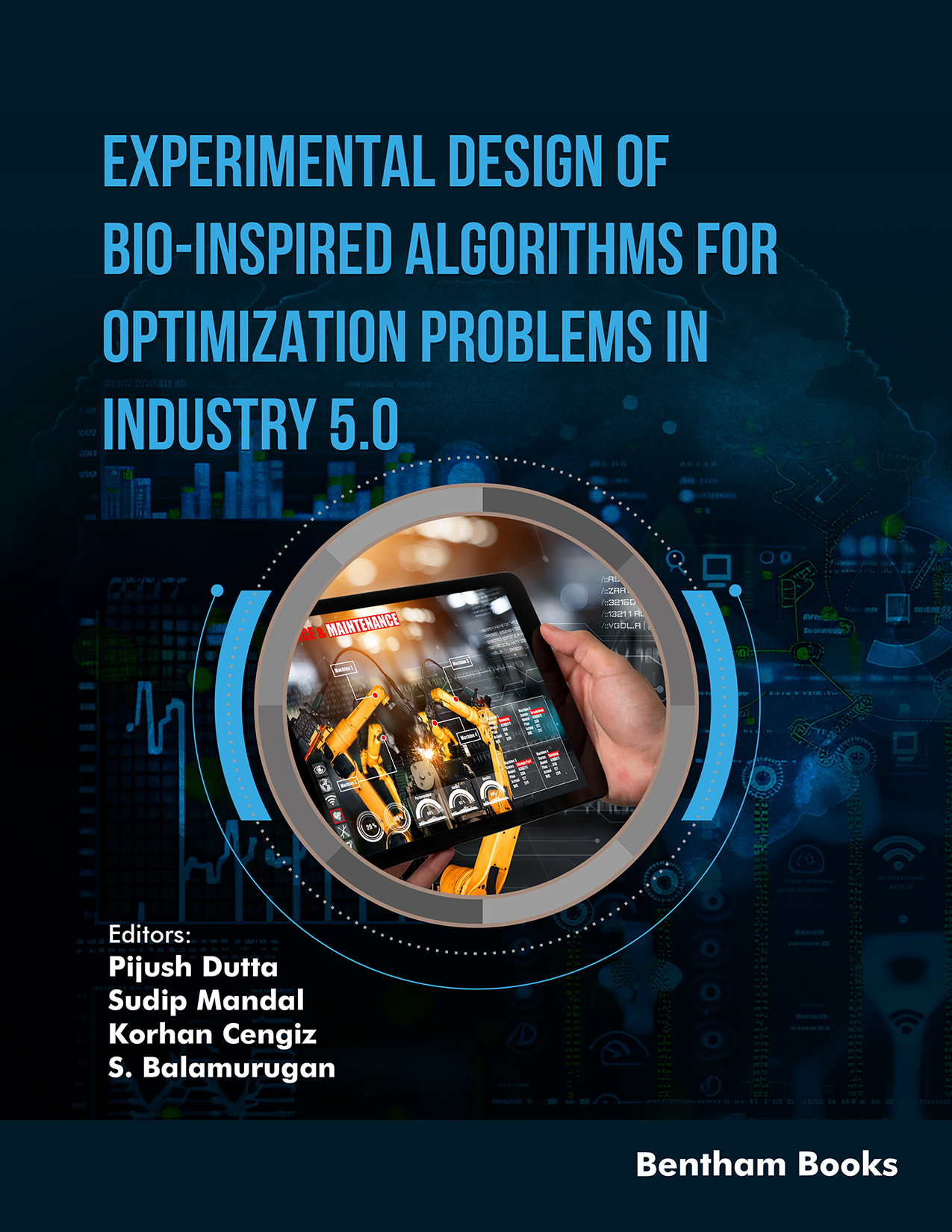
Editors: Pijush Dutta, Sudip Mandal, Korhan Cengiz, S. Balamurugan

Series Title: Applied Machine Learning for IoT and Data Analytics (Volume 1)

Experimental Design of Bio-Inspired Algorithms for Optimization Problems in Industry 5.0

Volume 1

eBook: US $119 Special Offer (PDF + Printed Copy): US $191
Printed Copy: US $131
Library License: US $476
ISBN: 979-8-89881-409-0 (Print)
ISBN: 979-8-89881-408-3 (Online)
Year of Publication: 2026
DOI: 10.2174/97988988140831260101

Introduction

Applied Machine Learning for IoT and Data Analytics (Volume 1) is an integrated exploration of nature-inspired optimisation techniques within the emerging Industry 5.0 paradigm- Positioned at the intersection of artificial intelligence, computational intelligence, industrial engineering, and cyber-physical systems, this volume centres on human-centricity, sustainability, resilience, and intelligent automation.

The book comprehensively reviews evolutionary computation, swarm intelligence, neural computation, and hybrid metaheuristics, explaining how these methods can be systematically designed, statistically validated, and benchmarked for real-world deployment. Foundational chapters address Explainable AI (XAI), statistical experimental design, ANOVA-based modelling, parameter tuning strategies, and performance evaluation frameworks.

Through fifteen carefully curated chapters, the book presents practical case studies in wireless sensor networks, smart manufacturing, micro-machining, welding optimisation, renewable energy systems, motor control, wireless communications, banking automation, and advanced antenna design. Emphasis is placed on experimental rigour, benchmarking, and reproducibility—bridging the gap between theoretical advancements and industrial implementation.


Key Features

  • - Comprehensive review of classical and hybrid bio-inspired algorithms.
  • - Integration of optimisation techniques within the Industry 5.0 framework.
  • - Covers Explainable AI for transparent optimisation systems with a strong focus on experimental design, ANOVA modelling, and statistical validation.
  • - Practical case studies across manufacturing, energy, communications, and automation.
  • - Emphasis on reproducibility and methodological rigour with forward-looking insights into AI-enhanced and explainable optimisation trends.

Target Readership:

Researchers, academics, doctoral scholars, and postgraduate students in artificial intelligence, optimisation, computational intelligence, industrial engineering, and Industry 5.0 studies.

Foreword

Industry 5.0, which emphasizes the collaboration of intelligent systems and humans to create highly personalized, efficient, and sustainable manufacturing processes, represents a significant change in how industries function. Industry 5.0 aims to establish a cooperative environment where artificial intelligence and human creativity may coexist peacefully, in contrast to its predecessor, which was mainly concerned with automation and cyber-physical systems. In this new industrial age, optimization is essential for solving complicated problems, from energy efficiency and resource allocation to dynamic production planning and real-time decision-making.

To address these complex optimization problems, bio-inspired algorithms—which draw inspiration from natural processes like evolution, swarm intelligence, and brain adaptation—have become very effective. They are ideal for the dynamic and unpredictable situations seen in Industry 5.0 applications due to their innate flexibility, adaptability, and capacity to break free from local optima. Bio-inspired optimization approaches provide creative ways to increase productivity, resilience, and sustainability as businesses get increasingly linked through the Internet of Things, edge computing, and artificial intelligence.

This book, "Experimental Design of Bio-Inspired Algorithms for Optimization Problems in Industry 5.0," is published at a pivotal point in time when industry applications and scholarly research must come together to fully use these methods. It methodically investigates experimental approaches that guarantee the effective application of bio-inspired algorithms in commercial contexts. The book explores important topics, including algorithm selection, parameter tweaking, performance benchmarking, and real-world application scenarios, through several perceptive chapters written by top specialists.

The well-organized combination of theoretical underpinnings and real-world applications will provide readers with the skills they need to successfully develop, apply, and assess bio-inspired algorithms. This book provides a lot of material to help you in your endeavors, whether you are a researcher investigating new optimization techniques or an industry expert looking for workable ways to improve operational efficiency.

I have no doubt that this book will be a priceless tool for practitioners, researchers, and students alike, spurring more advancements in bio-inspired optimization for Industry 5.0. It is admirable that the editors and collaborators put together such an extensive and progressive work. I invite you to explore the insights contained within these pages and leverage the knowledge presented to address the pressing optimization challenges of Industry 5.0.

We sincerely hope that readers will find this book informative and inspiring, and we extend our gratitude to all contributors for their invaluable efforts in making this work possible.

Mete Yaganoglu
Ataturk University, Faculty of Engineering
Department of Computer Engineering
Erzurum, Turkey