
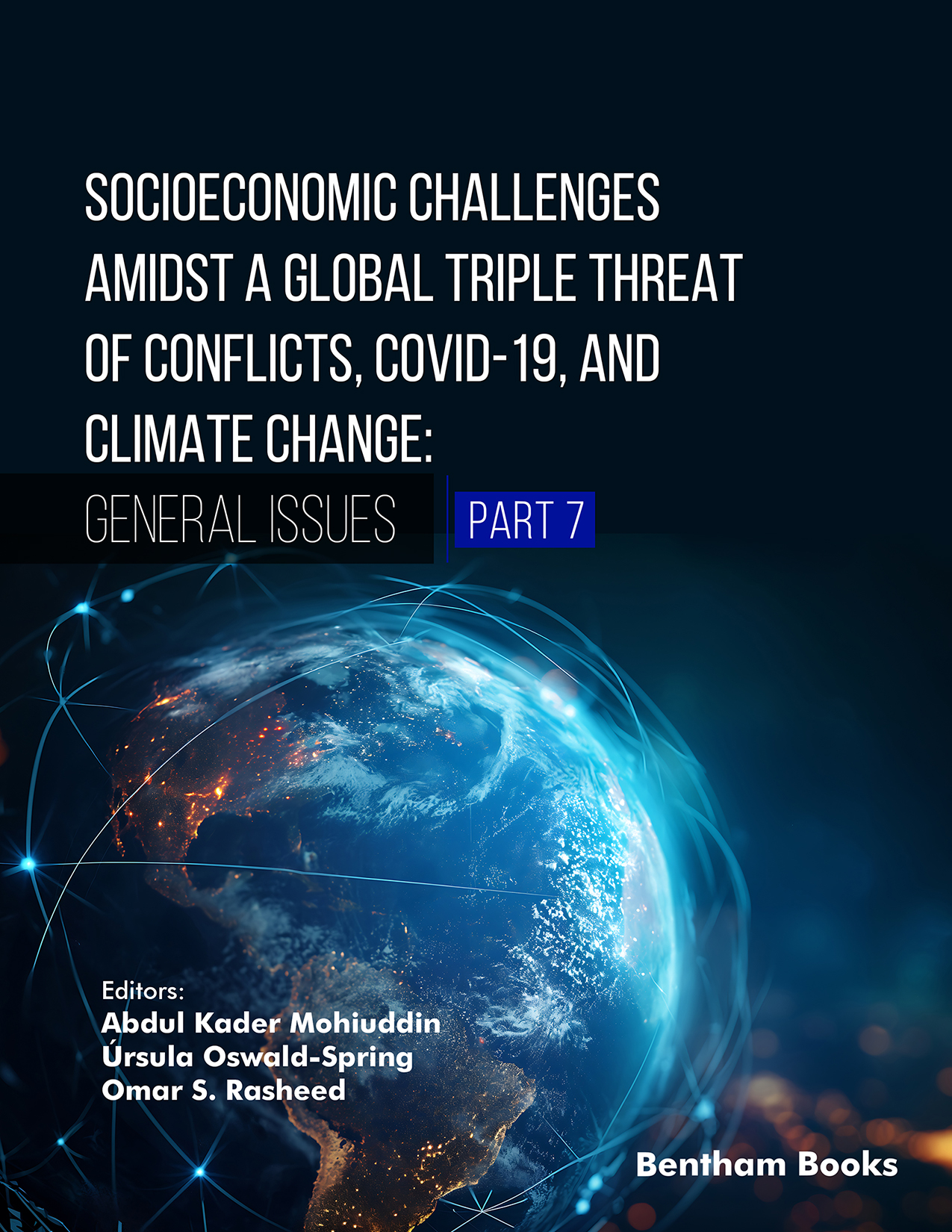
Editors: Abdul Kader Mohiuddin, Úrsula Oswald -Spring, Omar S. Rasheed

Socioeconomic Challenges Amidst a Global Triple Threat of Conflicts, COVID-19, and Climate Change: General Issues (Part 7)

eBook: US $79 Special Offer (PDF + Printed Copy): US $135
Printed Copy: US $95
Library License: US $316
ISBN: 979-8-89881-703-9 (Print)
ISBN: 979-8-89881-702-2 (Online)
Year of Publication: 2026
DOI: 10.2174/97988988170221260101

Introduction

The book explores the evolving global socioeconomic crisis shaped by the convergence of the COVID-19 pandemic, persistent cross-border and internal conflicts, international sanctions and recurring natural disasters. Situated within the broader field of global political economy and development studies, it examines how these overlapping shocks disrupt economic systems, trade and energy pathways and essential sectors such as healthcare, agriculture, education and communication. The central theme emphasizes the interconnected and mutually reinforcing nature of these crises, highlighting how structural vulnerabilities and human-driven factors intensify their scale and impact across both developed and developing regions.

A key strength of the book lies in its integrative, multidisciplinary approach, combining economic analysis with political and environmental perspectives. It offers structured and timely insights into developments across several regions and presents a human-centered narrative that consistently foregrounds the lived experiences of ordinary people, especially in war-torn and vulnerable societies.

The chapters collectively trace the progression of these crises across regions and sectors. Early sections examine the pandemic's economic and social aftermath, followed by analyses of major conflict zones—including Ukraine and the Middle East—and their far-reaching implications for global supply chains, food security and energy markets. Subsequent chapters explore the role of sanctions, climate stress and geopolitical tensions, particularly the ripple effects of U.S.–China rivalry, in reshaping global stability. Together, they reveal how strategic chokepoints such as the Strait of Hormuz and the Red Sea have become critical pressure points in an increasingly fragile global system.

Part 7 concludes the topics by covering global effects of healthcare system disruptions and how geopolitical tensions between the USA and China are impacting economic stability and trade.


Readership :

Primary readership: Researchers studying war and conflict, public health, epidemiology, international affairs, peace and conflict studies and health economics; diplomats, policy and development analysts and humanitarian workers.

Secondary readership: Students of sociology, economics, political science, international relations, development studies, environmental studies and global health; journalists, educators and general readers.

Preface

This book is conceived as an attempt to make sense of a world increasingly shaped by interlocking crises rather than isolated disruptions, where COVID-19, armed conflicts, and climate extremes operate not as separate events but as mutually reinforcing forces. The pandemic’s global shock did not simply represent a health emergency; it recalibrated economic systems, strained governance structures, and exposed deep inequalities that continue to persist in recovery trajectories. In parallel, escalating armed conflicts have intensified geopolitical fragmentation, disrupted trade corridors, displaced populations on a massive scale, and weakened institutional capacity across regions already under stress. Climate extremes, meanwhile, function as a persistent stress amplifier, accelerating resource scarcity, undermining agricultural stability, and worsening public health outcomes while interacting with both conflict and economic instability. Within this interconnected landscape, global health systems stand at the frontline of vulnerability, burdened by workforce shortages, unequal access, fragmented financing, and the compounding pressures of infectious disease outbreaks, non-communicable diseases, and emergency shocks. Food systems are similarly destabilized, as climate variability, conflict-driven disruption, and pandemic-era breakdowns in logistics converge to deepen global food insecurity and widen nutritional inequality. The U.S.–China rivalry adds another structural layer of fragmentation, reshaping global trade, technology flows, and industrial networks through strategic decoupling, export controls, and regional bloc formation, thereby altering long-established patterns of globalization. At the same time, global drug and medical supply chains reveal acute fragility, with concentrated production, geopolitical constraints, and logistical vulnerabilities producing recurrent shortages and inequities in access to essential medicines. These pressures are further magnified within broader supply chain systems, where disruptions originating from COVID-19 have been compounded by currency devaluation, exchange rate volatility, and financial instability, transforming efficiency-oriented global networks into structurally fragile and crisis-sensitive systems. Taken together, these domains illustrate a single systemic condition rather than parallel problems: a global order in which health, food, trade, finance, and security are deeply entangled, and where shocks in one sphere inevitably propagate across all others.

Abdul Kader Mohiuddin
Alumnus, Faculty of Pharmacy
Dhaka University, Dhaka, Bangladesh

Úrsula Oswald-Spring
Regional Multidisciplinary Research Center
National University of Mexico
Mexico city, Mexico

&

Omar S. Rasheed
University of Almería, Carretera Sacramento
S/N, La Cañada de San Urbano, 04120
Almería, Spain