
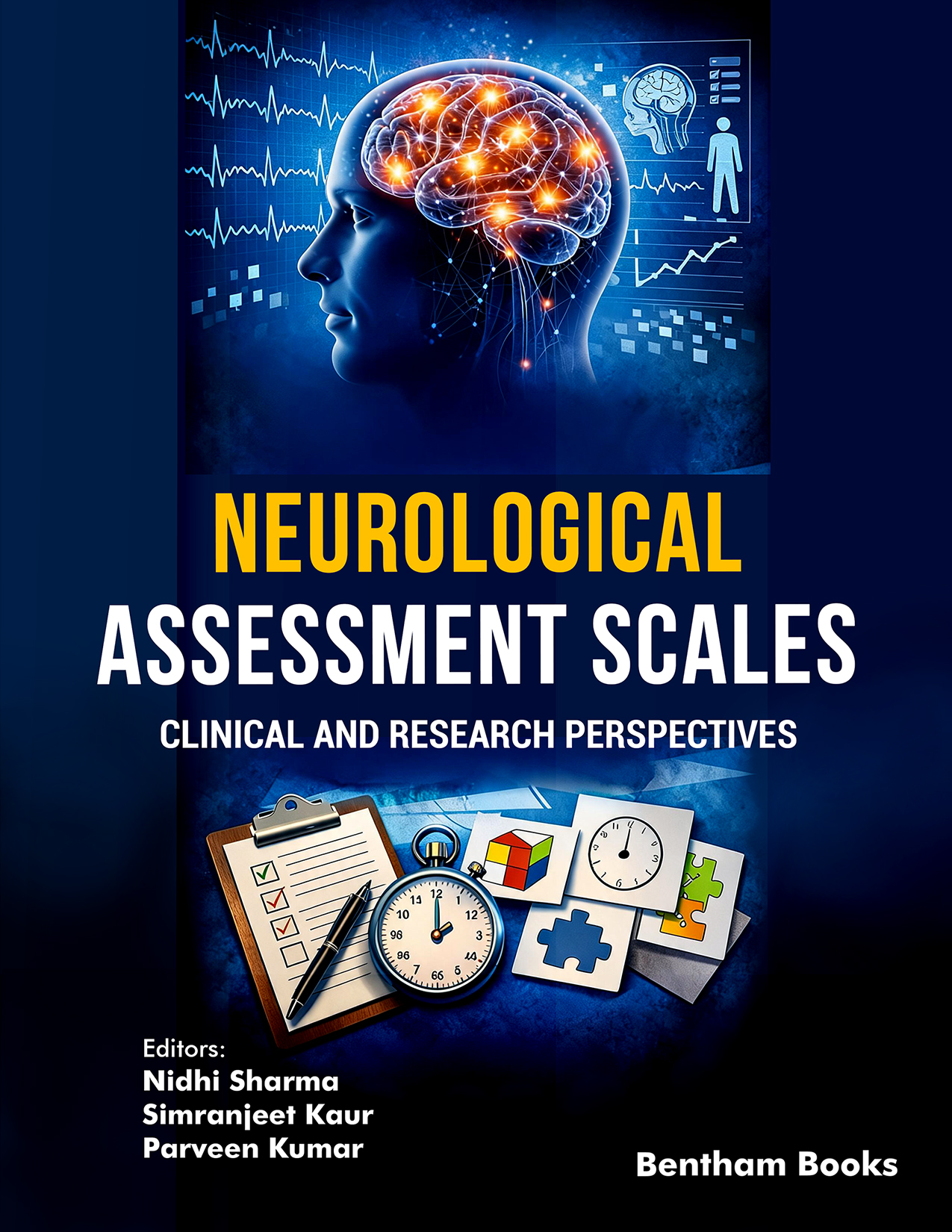
Editors: Nidhi Sharma, Simranjeet Kaur, Parveen Kumar

Neurological Assessment Scales: Clinical and Research Perspectives

eBook: US $49 Special Offer (PDF + Printed Copy): US $124
Printed Copy: US $99
Library License: US $196
ISBN: 979-8-89881-589-9 (Print)
ISBN: 979-8-89881-588-2 (Online)
Year of Publication: 2026
DOI: 10.2174/97988988158821260101

Introduction

Neurological Assessment Scales: Clinical and Research Perspectives is a practical guide to neurological assessment tools used in both clinical practice and research, with a strong focus on physiotherapy and neurorehabilitation. The book helps clinicians and researchers select appropriate scales for accurate, evidence-based evaluation across a wide range of neurological conditions.

The book covers major domains such as spasticity, ataxia, cognition, balance, coma, and neurological disorders, including Parkinson's disease, multiple sclerosis, spinal cord injury, traumatic brain injury, and Guillain-Barré syndrome.

Each chapter focuses on specific assessment scales (e.g., Ashworth, Tardieu, GCS, FOUR, UPDRS, SARA, ICARS) along with their administration, scoring methods, psychometric properties, strengths, limitations, and clinical applications.

The book also includes detailed scoring guidelines, reliability and validity data, multilingual adaptations, and practical tips for use in fast-paced clinical and research settings.


Key Features

  • - Comprehensive coverage of widely used assessment scales in neurology with step-by-step guidance on administration and scoring, including evaluation of reliability, validity, and clinical usefulness.
  • - Covers major neurological disorders and conditions with a focus on physiotherapy and neurorehabilitation applications.
  • - Provides a practical, quick-reference format for clinical and research use.

Target Readership :

Clinical researchers, students, therapists and professionals in neurology.

Preface

The realm of neurology thrives at the intersection of science and humanity, where precise measurements of neurological function meet the unpredictable narratives of individual patients. Neurological assessment scales stand as the bridge between these two worlds, offering quantifiable, evidence-based insights while honoring the complexities of human experience. This book, Neurological Assessment Scales: Clinical and Research Perspectives, was born from the need to consolidate the vast landscape of these tools into a single, accessible resource for clinicians, researchers, and students alike.

Standardized assessment scales have revolutionized neurological practice by enabling clinicians to diagnose more effectively, monitor disease progression accurately, and evaluate treatment outcomes consistently. In research, these scales provide the rigor necessary for reproducibility and the comparability essential for global collaboration. Whether it is measuring spasticity with the Modified Ashworth Scale, evaluating coma recovery using the Glasgow Coma Scale, or assessing the quality of life with the SF-36, these tools form the backbone of both bedside care and benchside innovation.

This book brings together a diverse array of assessment scales spanning 15 chapters, each written by field experts. It offers an in-depth look at tools for evaluating conditions ranging from spasticity, coma, and vertigo to Parkinson’s disease, multiple sclerosis, stroke, spinal cord injury, traumatic brain injury, and many more. The authors go beyond mere descriptions, presenting the clinical rationale, scoring, administration, interpretation, and psychometric properties of each scale. Also, the available modified version of the scales has been discussed. Readers will gain not only a reference guide but also a deeper understanding of how these tools shape decision-making in neurology.

Our aim is to make this book a cornerstone for those navigating the intricate pathways of neurological care and research. The content reflects a collaborative spirit, combining decades of clinical expertise and academic rigor. We hope this work will inspire confidence in its users, whether they are applying the tools in a bustling clinic, a quiet research lab, or a classroom filled with eager learners.

We extend our heartfelt gratitude to the contributors for their dedication to this endeavor and to Bentham Science Publishers for recognizing the significance of this compilation. We also thank the countless patients whose experiences have informed the creation and refinement of these scales; they remain the true focus of our collective efforts.

As neurology continues to evolve, so too will the tools we use to understand it. This book is not just a snapshot of the current state of neurological assessment but an invitation to future discoveries. We hope it serves as a trusted companion in your journey through the intricate world of neurological science.

Nidhi Sharma
Department of Physiotherapy
Amity Institute of Health Allied Sciences
Amity University, Noida
Uttar Pradesh, India

Simranjeet Kaur
Pal Physiotherapy and Rehabilitation Centre
Pal Healthcare, Jandli, Ambala City
Haryana, India

&

Parveen Kumar
Pal Physiotherapy and Rehabilitation Centre
Pal Healthcare, Jandli, Ambala City
Haryana, India