
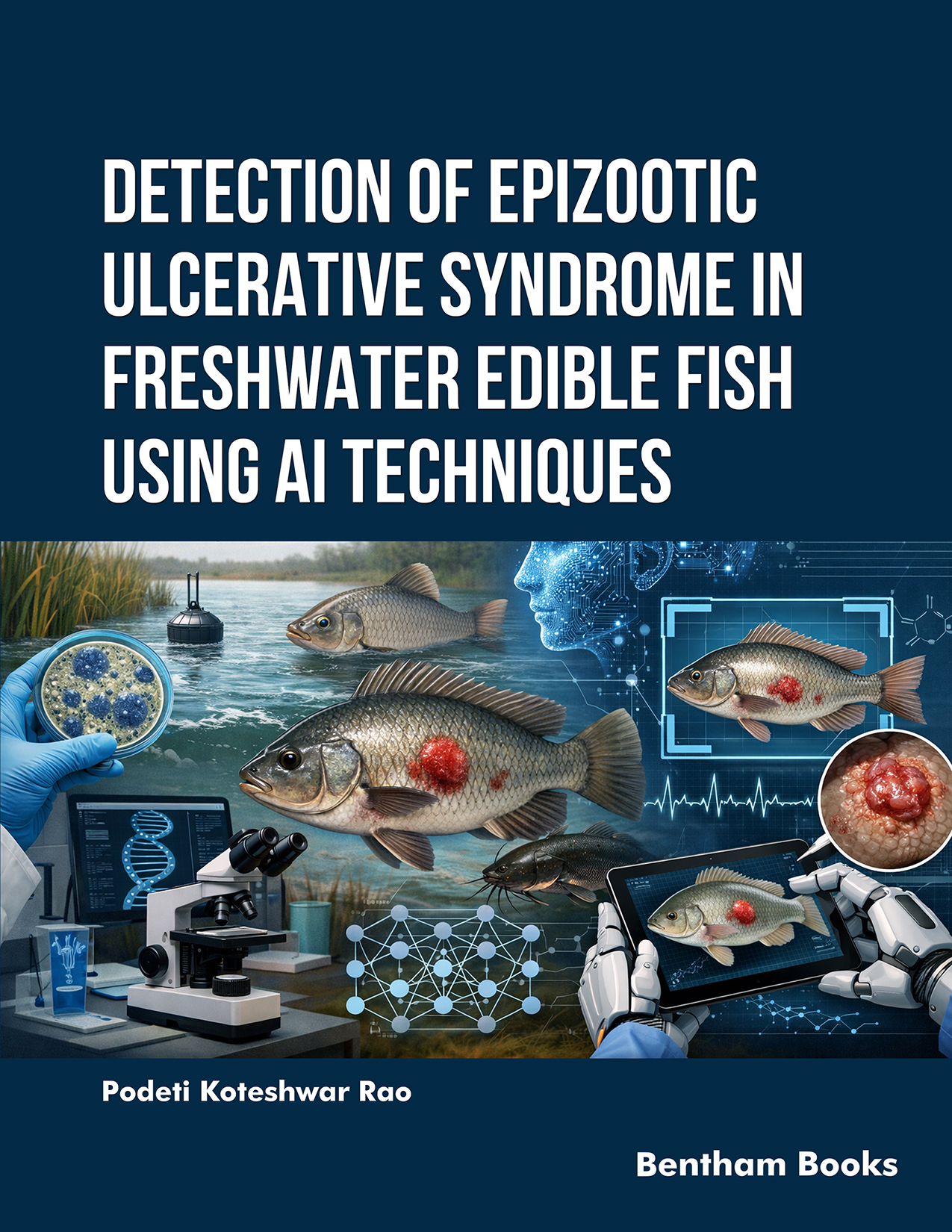
Author: Podeti Koteshwar Rao

Affiliation: Department of Zoology, SVS Degree and PG College, Affilitated to Kakatiya University, Warangal, Telangna, India

Detection of Epizootic Ulcerative Syndrome in Freshwater Edible Fish Using AI Techniques

eBook: US $79 Special Offer (PDF + Printed Copy): US $135
Printed Copy: US $95
Library License: US $316
ISBN: 979-8-89881-535-6 (Print)
ISBN: 979-8-89881-534-9 (Online)
Year of Publication: 2026
DOI: 10.2174/97988988153491260101

Introduction

Detection of Epizootic Ulcerative Syndrome in Freshwater Edible Fish Using AI Techniques explores innovative methods for identifying and managing a serious fish disease affecting aquaculture worldwide. Epizootic Ulcerative Syndrome (EUS), caused by the oomycete Aphanomyces invadans, leads to hemorrhagic ulcers, tissue necrosis, and high mortality in freshwater and estuarine fish, threatening food security and livelihoods.

Traditional detection relies on visual inspection or laboratory tests like PCR, which are accurate but slow and require skilled personnel. This book highlights how artificial intelligence (AI) and image-based machine learning can overcome these challenges. Techniques such as Principal Component Analysis (PCA) with feature detectors, neural networks, and deep learning architectures like MobileNetV2 are applied to automatically detect and classify EUS from fish images with high accuracy (≈84 %). Colour thresholding and object segmentation further improve the detection of affected regions.

By enabling rapid, scalable, and objective disease identification, these AI-driven approaches support early intervention, reduce economic losses, and empower farmers without specialised expertise. The book also discusses future improvements, including training models on diverse datasets to enhance field reliability and applicability.


Key Features

  • - Focus on Epizootic Ulcerative Syndrome (EUS) in freshwater edible fish.
  • - Use of AI and machine learning for automated, rapid disease detection.
  • - Techniques include PCA, feature detectors, neural networks, and deep learning (MobileNetV2).
  • - Practical applications for real-time monitoring in aquaculture.
  • - Strategies to reduce economic losses and improve fish health.

Target Readership :

Researchers, scientists, students and professionals in aquaculture, fisheries science, and veterinary studies.

Preface

Aquaculture is emerging as one of the most vital sectors in global food production, contributing significantly to nutrition, employment, and economic development. Among freshwater resources, edible fish species serve as a crucial protein source for millions of people, particularly in developing countries. However, the sustainability of aquaculture is severely threatened by infectious diseases, of which Epizootic Ulcerative Syndrome (EUS) is among the most destructive. EUS is a trans boundary aquatic disease, characterized by deep ulcerative lesions, extensive tissue necrosis, and high mortality rates in susceptible fish species. Its outbreaks not only cause severe economic losses to farmers but also affect food security and ecosystem health.

Traditionally, the diagnosis of EUS has relied on clinical observation, histopathological examination, and microbiological or molecular techniques. While effective, these methods are often limited by delays, the need for specialized expertise, and high operational costs. In an industry where timely detection is the difference between containment and catastrophic loss, there is an urgent need for innovative, rapid, and reliable diagnostic solutions.

This research introduces Artificial Intelligence (AI) as a transformative tool for the detection of EUS in freshwater edible fish. AI techniques, particularly machine learning, deep learning, and image recognition, offer the ability to analyze complex datasets, identify subtle pathological features, and provide real-time diagnostic support. By applying AI to fish health monitoring, this work seeks to bridge the gap between traditional diagnostic practices and the need for scalable, automated systems that can be deployed even in resource-limited aquaculture settings. The preface to this study emphasizes the interdisciplinary nature of the work. It brings together insights from aquaculture, veterinary pathology, computational biology, and artificial intelligence. Such convergence is vital for developing next-generation solutions that ensure both the economic viability of aquaculture and the safety of food supplies. Moreover, the approach discussed herein demonstrates how AI can be harnessed not only for accurate disease detection but also for predictive surveillance, enabling farmers and policymakers to anticipate and mitigate outbreaks before they escalate.

This endeavor is motivated by the vision of fostering sustainable aquaculture through technological innovation. By combining biological understanding with computational intelligence, the study aspires to contribute toward improved fish health management, reduced economic vulnerability, and strengthened food security. The application of AI in detecting EUS is more than a technological advancement; it represents a paradigm shift towards precision aquaculture, where science and technology work hand in hand to secure the future of freshwater resources.

Podeti Koteshwar Rao
Department of Zoology
SVS Degree and PG College
Affilitated to Kakatiya University
Warangal, Telangna, India