
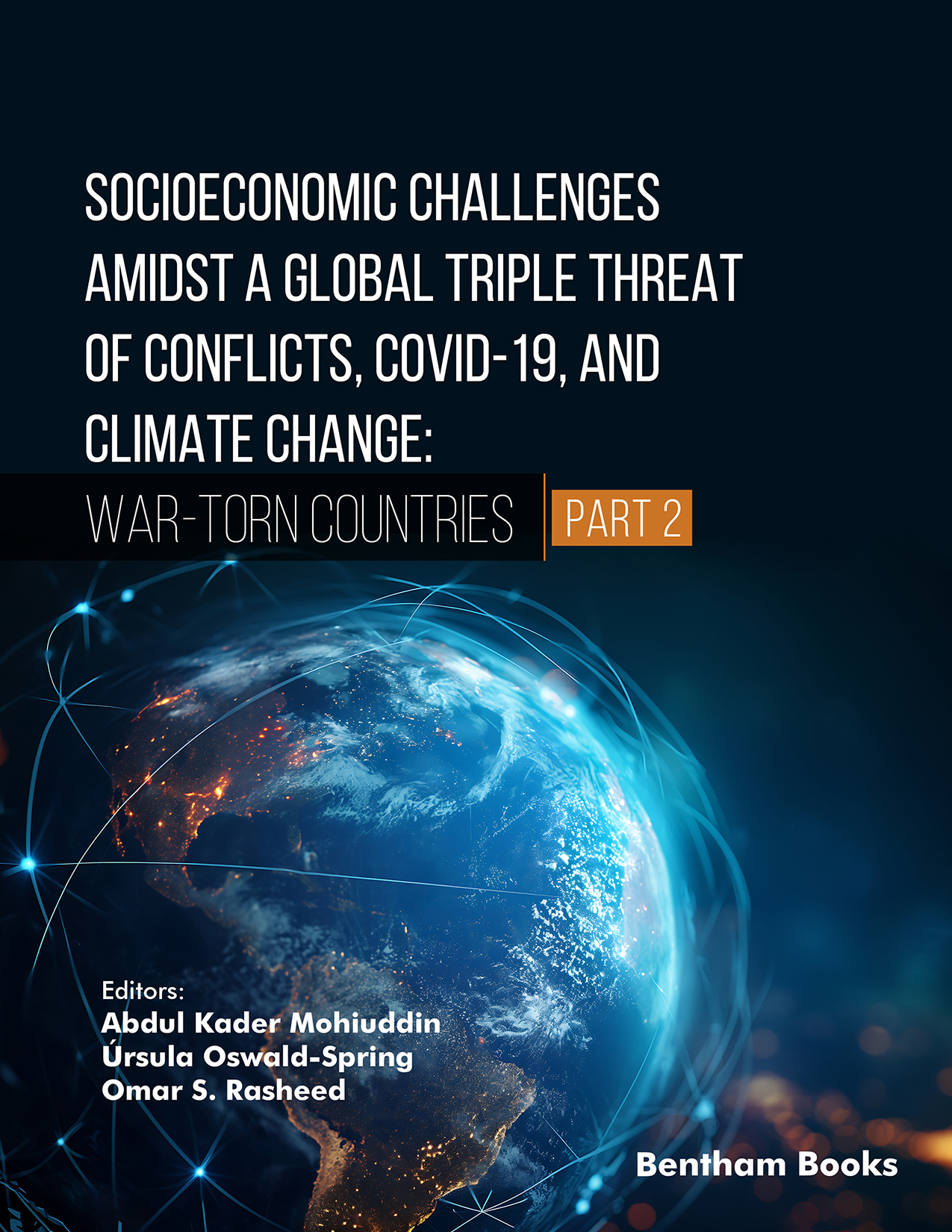
Editors: Abdul Kader Mohiuddin, Úrsula Oswald -Spring, Omar S. Rasheed

Socioeconomic Challenges Amidst a Global Triple Threat of Conflicts, COVID-19, and Climate Change: War-torn Countries (Part 2)

eBook: US $89 Special Offer (PDF + Printed Copy): US $161
Printed Copy: US $116
Library License: US $356
ISBN: 979-8-89881-463-2 (Print)
ISBN: 979-8-89881-462-5 (Online)
Year of Publication: 2026
DOI: 10.2174/97988988146251260101

Introduction

The book explores the evolving global socioeconomic crisis shaped by the convergence of the COVID-19 pandemic, persistent cross-border and internal conflicts, international sanctions and recurring natural disasters. Situated within the broader field of global political economy and development studies, it examines how these overlapping shocks disrupt economic systems, trade and energy pathways and essential sectors such as healthcare, agriculture, education and communication. The central theme emphasises the interconnected and mutually reinforcing nature of these crises, highlighting how structural vulnerabilities and human-driven factors intensify their scale and impact across both developed and developing regions.

A key strength of the book lies in its integrative, multidisciplinary approach, combining economic analysis with political and environmental perspectives. It offers structured and timely insights into developments across several regions. It presents a human-centred narrative that consistently foregrounds the lived experiences of ordinary people, especially in war-torn and vulnerable societies.

The chapters collectively trace the progression of these crises across regions and sectors. Early sections examine the pandemic's economic and social aftermath, followed by analyses of major conflict zones including Ukraine and the Middle East—and their far-reaching implications for global supply chains, food security and energy markets. Subsequent chapters explore the role of sanctions, climate stress and geopolitical tensions, particularly the ripple effects of U.S.–China rivalry, in reshaping global stability. Together, they reveal how strategic chokepoints such as the Strait of Hormuz and the Red Sea have become critical pressure points in an increasingly fragile global system.

Part 2 continues the section on war-torn countries, covering issues related to the Israel-Palestine conflict, Ethiopia, Iraq, and Congo.


Target Readership :

Researchers and students studying war and conflict, public health, epidemiology, international affairs, peace and conflict studies and health economics; diplomats, policy and development analysts and humanitarian workers.

Preface

In many of today’s conflicts, war is not a choice made by ordinary people but a condition forced upon them by forces far beyond their control. Political ambition, strategic rivalries, and the narrow interests of a few often ignite and sustain violence, while civilians—who neither shape these decisions nor benefit from them—are left to endure the consequences. In places like the Gaza Strip, Iraq, Tigray, and the Democratic Republic of the Congo, daily life has become a fragile struggle for survival, where safety and dignity can no longer be taken for granted. Prolonged conflict delivers a relentless “triple shock,” as violence, economic collapse, and failing institutions slowly dismantle the rhythms of normal life. Livelihoods disappear, prices spiral beyond reach, and families are pushed into poverty not by choice but by circumstance. Hunger deepens into famine as food systems break down or are deliberately obstructed, while shattered health and sanitation systems leave communities exposed to disease and silent suffering. Many are forced to flee their homes, crossing borders with little more than hope, while others return after brief truces only to find themselves trapped in yet another cycle of destruction. Education fades into the background, replaced by survival, and entire generations grow up without the stability needed to imagine a different future. For millions, peace remains a distant, almost abstract dream, glimpsed but rarely sustained. Amid rubble and uncertainty, children still dare to hope for safety, for classrooms, for a life not defined by fear. What lingers beyond the visible ruins is a quieter, more enduring loss—the erosion of hope itself, as lives are shaped more by absence than by possibility. In the end, the heaviest burden of war is carried by those who never chose it, yet must live with its deepest and most lasting scars.

Abdul Kader Mohiuddin
Alumnus, Faculty of Pharmacy, Dhaka University
Dhaka, Bangladesh

Úrsula Oswald-Spring
Regional Multidisciplinary Research Center
National University of Mexico
Mexico City, Mexico

&

Omar S. Rasheed
University of Almería, Carretera Sacramento
S/N, La Cañada de San Urbano, 04120
Almería, Spain