
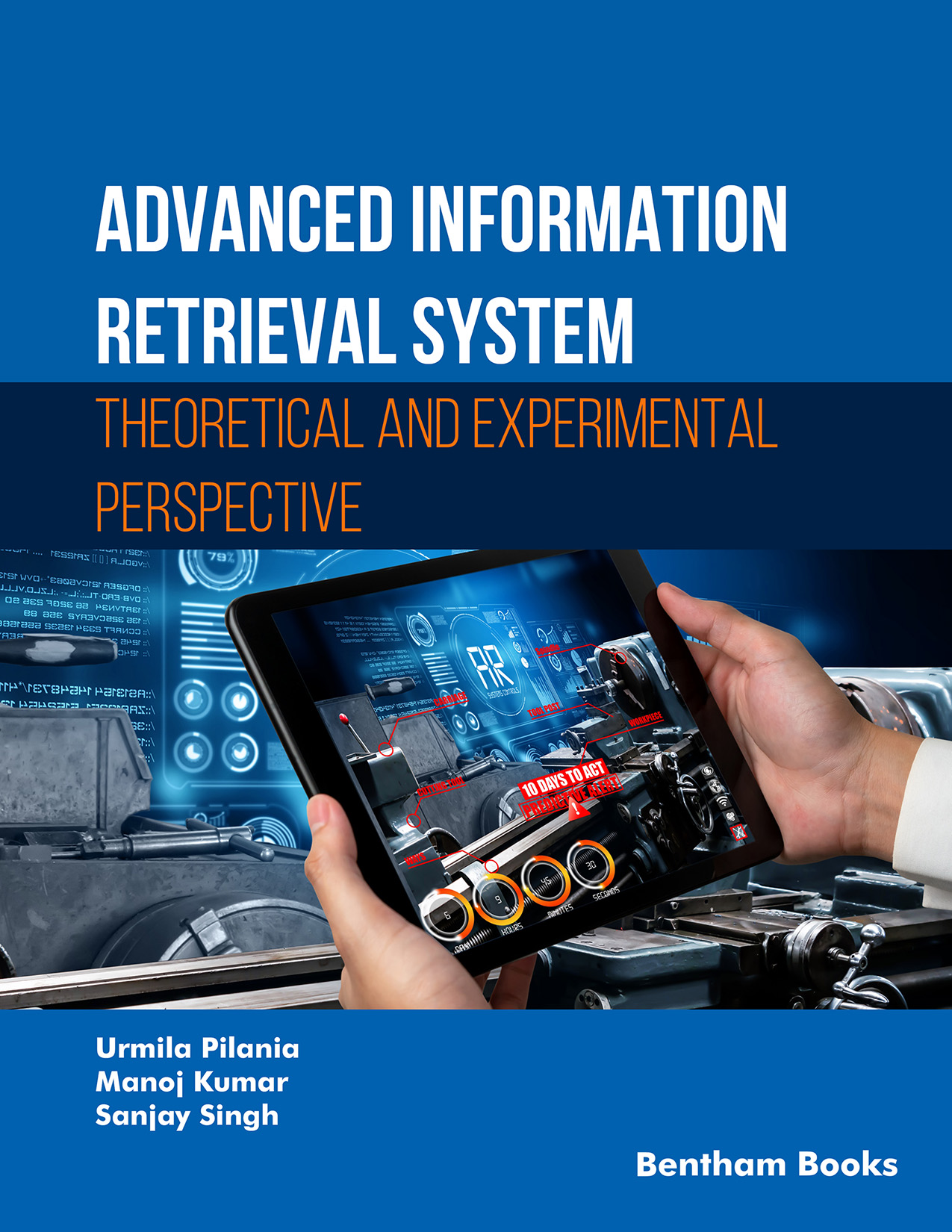
Authors: Urmila Pilania, Manoj Kumar, Sanjay Singh

Advanced Information Retrieval System: Theoretical and Experimental Perspective

eBook: US $59 Special Offer (PDF + Printed Copy): US $95
Printed Copy: US $65
Library License: US $236
ISBN: 979-8-89881-367-3 (Print)
ISBN: 979-8-89881-366-6 (Online)
Year of Publication: 2026
DOI: 10.2174/97988988136661260101

Introduction

Advanced Information Retrieval System: Theoretical and Experimental Perspective blends foundational theory with practicality to provide an integrative exploration of modern information retrieval (IR) systems. This volume examines a wide range of IR methodologies, from classical indexing and ranking techniques to cutting-edge AI-driven approaches, demonstrating how these systems can be applied across diverse domains, including web search, recommendation systems, sentiment analysis, and multimedia retrieval.

The book takes a structured approach towards guiding readers from traditional IR models to advanced, hybrid frameworks. The early chapters focus on classical and modern retrieval techniques with comparative analyses of different methods. Subsequent chapters focus on applied scenarios such as tourism recommender systems, sentiment mining from YouTube comments, book and medicine recommendation engines, and image-audio-based retrieval systems. Advanced topics include semantic role classification using BERT, hybrid filtering methods, personalised web crawlers, and experimental studies on smoothing techniques. Real-world case studies and experimental evaluations illustrate how theoretical models translate into effective, domain-specific IR applications.


Key Features

  • - Comprehensive coverage of traditional, modern, and hybrid IR techniques.
  • - Practical frameworks for recommendation systems, sentiment analysis, and web crawling.
  • - Integration of AI and machine learning methods, including BERT and TF-IDF models.
  • - Experimental evaluations and comparative analyses across multiple domains.
  • - Real-world applications spanning tourism, healthcare, fashion, and multimedia retrieval.

Target Readership:

Graduate students, researchers, academics and professionals in computer science, information retrieval, data science, AI, and machine learning.

Foreword

Information Retrieval is considered a remarkable AI-driven system due to its outstanding progress and continuous assessment. Information retrieval is applied in computer science, medical data analysis, statistics, as well as in blogs and newspapers, due to its interdisciplinary nature. Theoretical aspects of IR form the basis of any scientific discipline. The initial four to five chapters of the proposed book provide a theoretical understanding and comprehensive review of IR techniques. The subsequent chapters will then transition to more advanced techniques, such as AI, deep learning, and data mining, for applicability in real-life chapters. Theory without experimental results is incomplete, so the authors have added a significant portion to support the experimental perspective.

This book encompasses both theoretical and practical approaches in relation to real-world applications. The book will cover the latest methods in AI, big data, data mining, multimedia retrieval, and personalization. What makes this book different is its systematic presentation, including foundational areas like indexing, ranking algorithms, query processing, relevance feedback, and evaluation metrics, as well as newer topics like semantic retrieval, integration of machine learning techniques, and user behavior modeling. Not only does it foster learning, but it also encourages innovation, which has served as a great foundation for academic research and system development.

The book will be valuable for students, academicians, and researchers, presenting the integration of the latest technologies for building more efficient and effective IR systems. The authors are certain that the proposed book will make a significant contribution to the field of information retrieval.

It will work as a good reference book for graduate and post-graduate students, containing a wide range of topics from basic concepts to advanced experiments. This book also provides a detailed discussion on experimental design, data collection, and evaluation metrics, assisting researchers in designing robust and reliable IR experiments. Identification of emerging trends helps researchers identify new opportunities for their problem statements. For academicians, it acts as a valuable resource for a structured and detailed course on both theoretical and experimental perspectives in the field.

Dipali Bansal
Department of Computer Science and Technology
Manav Rachna University
Faridabad, India