
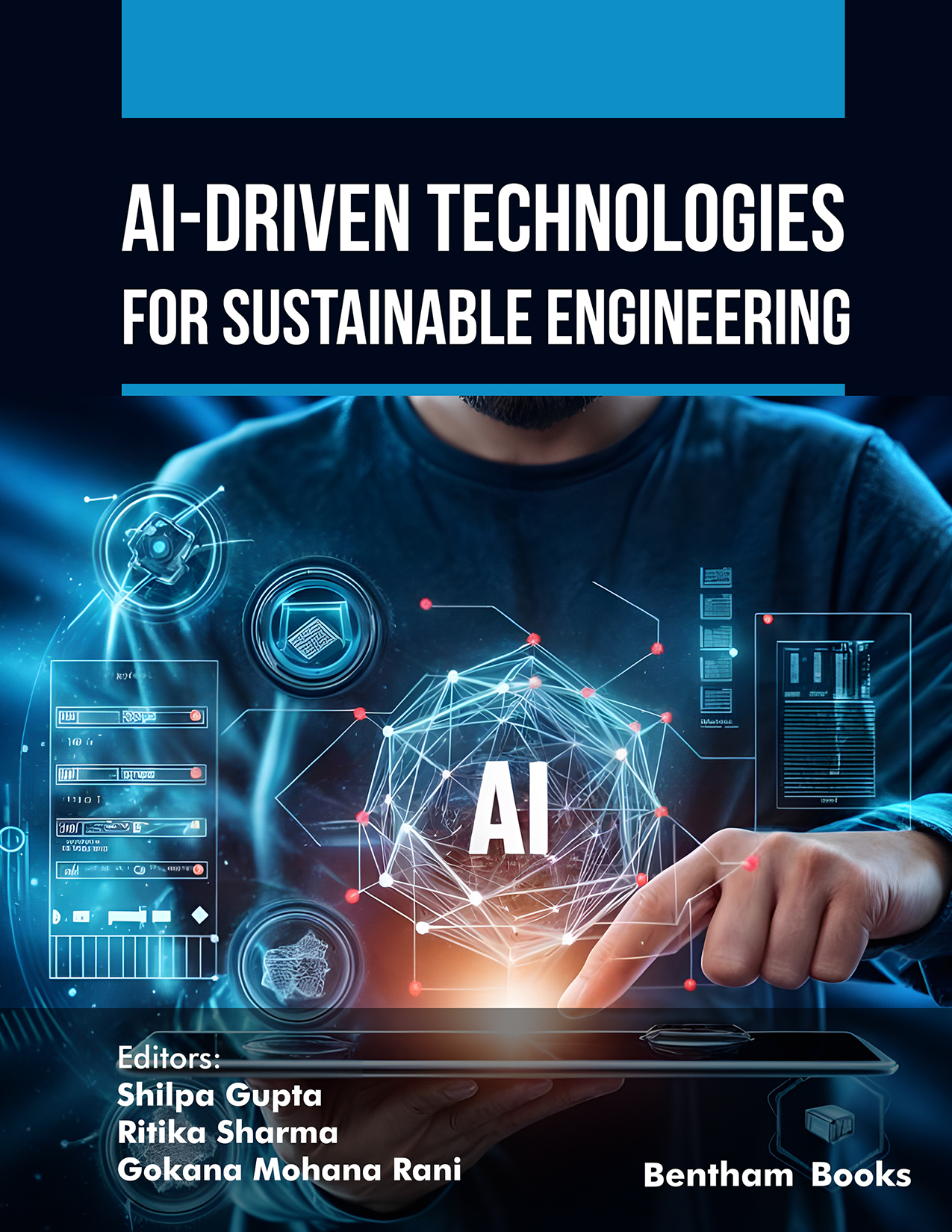
Editors: Shilpa Gupta, Ritika Sharma, Gokana Mohana Rani

Series Title: AI and Emerging Technologies for a Sustainable Future

AI-Driven Technologies for Sustainable Engineering

Volume 1

eBook: US $49 Special Offer (PDF + Printed Copy): US $89
Printed Copy: US $64
Library License: US $196
ISBN: 979-8-89881-295-9 (Print)
ISBN: 979-8-89881-294-2 (Online)
Year of Publication: 2025
DOI: 10.2174/97988988129421250101

Introduction

Learn how artificial intelligence is reshaping sustainable development across engineering domains with AI-Driven Technologies for Sustainable Engineering. The book demonstrates how AI-infused solutions can strengthen resilience, enhance efficiency, and support global sustainability goals.

Spanning topics ranging from IoT, healthcare, water systems, smart cities, to nanotechnology, education, and renewable energy, each chapter presents in-depth discussions supported by real-world case studies, illustrating how intelligent systems from automation to predictive analytics are reducing environmental impact and enabling responsible innovation. Challenging the perception that technology contributes primarily to degradation, this book highlights how data-driven intelligence can instead reverse harmful trends and serve as a catalyst for sustainable transformation.

Key Features

  • - Covers diverse AI applications across engineering fields including renewable energy, healthcare, education, transportation, and smart infrastructure.
  • - Aligns AI-enabled solutions with the United Nations Sustainable Development Goals (SDGs).
  • - Bridges research and real-world practice through detailed case studies and applied examples.
  • - Presents insights from leading experts, offering a multidisciplinary understanding of sustainable engineering.

Target Readership:

Graduate students, AI practitioners, data scientists, and technology strategists.

Preface

In an era where the world is racing with technological developments and simultaneously witnessing growing concerns for the environment, the need for AI in readjusting engineering practices to sustainability is at its most critical point. The interaction of AI-driven technologies and sustainable principles in engineering ensures that there is every opportunity to address complex environmental issues, with optimal resource efficiency and minimum carbon footprint.

This book, AI-Driven Technologies for Sustainable Engineering, investigates how AI may be used holistically to provide creative solutions while also promoting environmental stewardship, economic viability, and social well-being. Predictive analytics provides improved energy efficiency in smart grids, precision agricultural models supported by machine learning, decreased water loss through water-wasting reduction, and many more applications with wide application areas across industries.

We dive into this topic, not just to present current state-of-the-art AI-driven solutions but to encourage readers to question the long-standing paradigms of engineering. This book collects a collection of topics across interdisciplinary lines, such as applications of AI in IoT, education, healthcare, water resources, smart cities, and nanotechnology. Each chapter contains in-depth talks, real-world case studies, and future trends that will be demonstrated in the use of AI for sustainable innovation.

This book concept arose from the observation that while technology is frequently viewed as the source of deterioration when used intelligently, it can reverse these tendencies. With the ability of AI to process huge datasets, generate actionable insights, and automate complex processes, we are now armed with tools that can foster sustainable practices on a scale previously unattainable.

We are deeply thankful to the researchers, practitioners, and thought leaders who have given their expertise to this volume. Their pioneering work and thoughts have made this book extraordinarily rich, bringing enormous value to engineers, researchers, and students who care about a sustainable future.

We hope that this book will be both informative and inspiring.

Shilpa Gupta
Electronics and Communication Department
Chandigarh University, Punjab
India

Ritika Sharma
Computer Science and Engineering Department
Maharaja Agrasen University, Baddi
Himachal Pradesh, India

&

Gokana Mohana Rani
Department of Biological Sciences
and Bioengineering, Inha University
Incheon, South Korea